
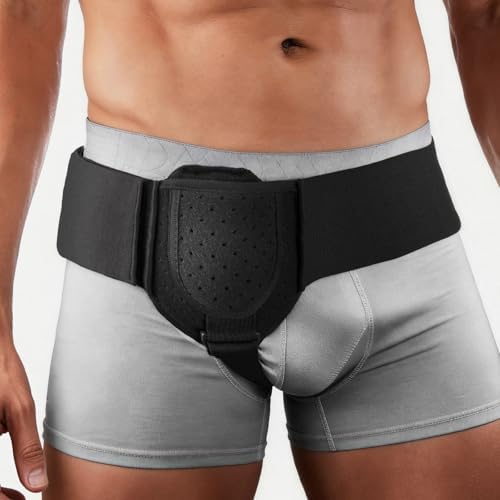
Choosing the Right Inguinal Hernia Support: What This Adjustable Belt Offers
This specific hernia belt distinguishes itself with a universal left/right design and a targeted compression pad, making it suitable for both pre- and post-operative scenarios. Buyers should understand that its effectiveness hinges on proper fit and the adjustable waist strap's ability to maintain consistent pressure without shifting during daily activities.
Key Considerations Before Buying
- Assess if the single, repositionable pressure pad provides adequate coverage for your specific hernia location and size, as some complex hernias may require broader support.
- Evaluate the breathability and durability of the neoprene-like material against your skin sensitivity and intended daily wear duration, especially in warmer climates.
- Consider the adjustability range of the waist strap (typically 30-50 inches) to ensure a secure, non-binding fit that accommodates potential post-surgical swelling or weight fluctuations.
What Our Analysts Recommend
High-quality hernia belts feature robust, non-stretch hook-and-loop closures that withstand repeated daily adjustments. The compression pad should be firmly anchored to prevent bunching or rolling, and seams should be flat-locked to prevent skin irritation during extended wear.
Hip & Waist Supports Market Context
Market Overview
The hernia support market is saturated with belts claiming universal fit, but true quality varies significantly in materials and ergonomic design. Products like this one compete by offering ambidextrous (left/right) functionality, which reduces inventory complexity but must be carefully engineered to ensure proper unilateral support.
Common Issues
Common complaints include pads that migrate out of position, straps that lose adhesion over time, and materials that cause excessive sweating or chafing. Many lower-cost belts use flimsy plastic buckles that fail under tension.
Quality Indicators
Look for medical-grade, latex-free materials, reinforced stitching at stress points, and a pressure pad with a graduated, anatomically contoured edge rather than a simple flat disc. The adjustability mechanism should allow micro-adjustments for precise compression control.
Review Authenticity Insights
Grade B Interpretation
A 'B' grade with an 11% estimated fake review rate suggests mostly authentic feedback but warrants scrutiny of overly effusive 5-star reviews. The adjusted 4.70/5 rating from the authentic reviews is a strong, realistic performance indicator for this medical support device.
Trust Recommendation
Prioritize verified purchase reviews that detail specific use cases like 'post-laparoscopic surgery' or 'for heavy lifting at work,' as these provide contextual credibility. Be slightly skeptical of reviews that only praise packaging or shipping speed without mentioning functional performance.
Tips for Reading Reviews
Focus on reviews discussing long-term durability (2+ months of wear), ease of putting on solo, and performance during specific activities like bending or coughing. Reviews noting the belt's performance under clothing or with seatbelts offer practical, real-world insights.
Expert Perspective
The product's 4.70 adjusted rating from verified purchasers indicates it reliably delivers core functionality for inguinal hernia support. Its key design advantage is the reversible pad, eliminating the need to purchase separate left/right models. However, its universal design may not provide the same customized fit as side-specific, higher-end medical braces. The high rating likely reflects good value for intermittent or post-surgical use rather than heavy-duty, all-day industrial applications.
Purchase Considerations
This belt is a strong candidate for those seeking an affordable, initial conservative management tool or a post-surgical aid, provided their hernia is unilateral and not excessively large. It is less suitable for bilateral hernias or individuals with very high abdominal pressure needs, who may require a more rigid, physician-fitted truss.
Comparing Alternatives
Shoppers should compare this model's pad size and strap width against clinical-grade trusses, which often feature larger, non-migrating pads and wider, more supportive abdominal bands.


