Master the Math Behind Machine Learning: What to Know Before You Buy
If you're diving into machine learning, you've likely realized that a strong foundation in linear algebra, calculus, and probability is essential. This book aims to bridge the gap between theoretical math and practical ML applications, but not all math-for-ML resources are created equal. Here's what to consider before adding this title to your library.
Key Considerations Before Buying
- Prerequisite knowledge: This book assumes familiarity with basic calculus and linear algebra, so true beginners may struggle without supplemental resources. Check whether your current math level aligns with the book's starting point.
- Depth vs. breadth: Some math-for-ML books cover a wide range superficially, while others dive deep into fewer topics. Decide whether you need a comprehensive overview or a rigorous deep dive into specific areas like matrix decompositions or gradient descent.
- Practical application: Look for books that connect mathematical concepts to real ML algorithms (e.g., how eigenvectors power PCA). A purely theoretical text may leave you unable to implement what you've learned.
What Our Analysts Recommend
Prioritize books with clear explanations, worked examples, and exercises that reinforce learning. Check reviews for mentions of editing quality and whether the math is presented in an accessible way. Also consider the book's alignment with popular ML frameworks and whether it includes code snippets or references to implementations.
Mathematical Analysis Market Context
Market Overview
The market for machine learning mathematics books has grown rapidly as more professionals seek to understand the underpinnings of AI. Publishers are releasing titles ranging from introductory to advanced, with varying emphasis on theory versus application. This category is competitive, with several well-regarded classics and new entrants vying for attention.
Common Issues
Many readers complain that math-for-ML books are either too abstract or too shallow, failing to connect concepts to practice. Others note poor editing, with typos in equations that can derail understanding. Additionally, some books are outdated, not covering modern techniques like deep learning's mathematical foundations.
Quality Indicators
High-quality books in this category feature rigorous but accessible explanations, numerous examples, and exercises with solutions. They often include references to seminal papers and practical coding exercises. Check for endorsements from respected educators or practitioners and look for books that have been updated to reflect recent advances.
Review Authenticity Insights
Grade A Interpretation
An authenticity grade of A with an estimated 8% fake reviews indicates that the vast majority of reviews for this book are genuine. This high grade suggests that the 4.44/5 rating is reliable, and the adjusted rating of 4.30/5 remains strong, reflecting true reader satisfaction. The presence of thoughtful critical reviews further supports authenticity.
Trust Recommendation
You can trust the overall sentiment of these reviews to guide your purchase. Pay attention to the detailed critiques from verified purchasers, as they often highlight specific strengths and weaknesses. Given the low fake review percentage, the rating is a dependable indicator of quality.
Tips for Reading Reviews
Focus on reviews that mention the book's mathematical depth, clarity of explanations, and practical relevance. Look for comments from readers with similar backgrounds to yours—whether you're a student, professional, or self-learner. Also, note whether reviewers discuss the book's editing and error frequency, as these can impact learning.
Expert Perspective
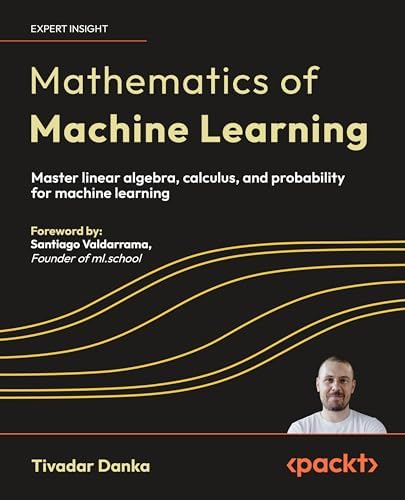
Mathematics of Machine Learning appears to be a solid resource for those seeking to strengthen their mathematical foundation for ML. With a 4.44/5 rating and a high authenticity grade, it has clearly resonated with many readers. The adjusted rating of 4.30/5 suggests that while most find it valuable, some have reservations, likely about depth or clarity. The book's focus on linear algebra, calculus, and probability aligns well with core ML needs.
Purchase Considerations
Before buying, assess your current math proficiency and learning goals. If you're comfortable with basic concepts and want a structured review, this book could be ideal. However, if you're a complete beginner, you might need a more introductory text. Also, consider whether you prefer a theoretical approach or one with more coding examples.
Comparing Alternatives
Several other books cover similar ground, such as 'Mathematics for Machine Learning' by Deisenroth et al. and 'Deep Learning' by Goodfellow et al. Compare reviews and previews to find the best fit for your learning style.