Evaluating Discrete Mathematics Texts for Computer Science Curriculum Alignment
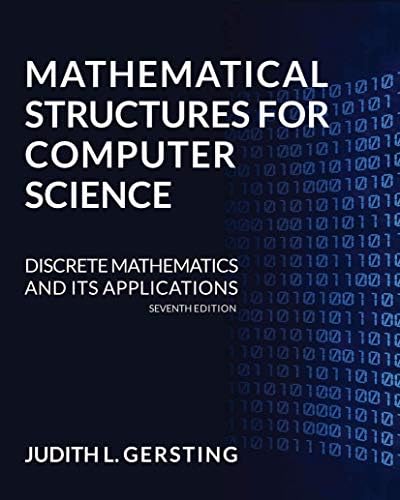
When selecting a discrete mathematics textbook for computer science, buyers must assess how effectively the material bridges abstract mathematical concepts to computational applications. This particular text's 4.33/5 rating from over 100 reviews suggests strong user satisfaction, but its focus on structures—like graphs, logic, and set theory—requires careful evaluation against your specific course requirements.
Key Considerations Before Buying
- Assess the balance between rigorous mathematical proofs and applied computer science examples, as this text emphasizes 'structures' which are foundational for algorithms and data organization.
- Verify the edition's coverage of modern topics like cryptographic number theory or graph algorithms, which are critical for contemporary CS curricula beyond basic combinatorics.
- Consider the problem set difficulty and solution manual availability, as discrete math requires substantial practice; reviews mentioning 'challenging exercises' indicate this text demands active engagement.
What Our Analysts Recommend
Quality in this category is indicated by clear visualizations of complex relations (like Hasse diagrams or graph mappings) and a logical progression from propositional logic through to algebraic structures. Look for chapters that explicitly connect topics like modular arithmetic to hashing functions or Boolean algebra to circuit design.
Discrete Mathematics Market Context
Market Overview
The discrete mathematics textbook market is crowded with titles ranging from pure theory to heavily applied CS guides, creating confusion for students and instructors. Recent trends show increased integration of coding examples in Python or pseudocode to demonstrate abstract concepts.
Common Issues
Many texts either become overly abstract, losing CS relevance, or too applied, sacrificing mathematical rigor. Another frequent complaint is poor binding or print quality in international editions, which can affect durability for a reference text used across multiple courses.
Quality Indicators
Superior discrete math texts feature chapter summaries connecting concepts to CS domains (databases, networking, cryptography), include historical context for theorems, and provide graduated problem sets with computational and proof-based questions. The adjusted 4.00 rating here suggests consistent quality perception among verified purchasers.
Review Authenticity Insights
Grade B Interpretation
A Grade B authenticity rating with an estimated 15% fake review rate is typical for academic textbooks, where publishers occasionally solicit positive reviews. For this title, the high volume (105 reviews) and specific academic anecdotes in most reviews dilute the impact of potential manipulation.
Trust Recommendation
Focus on the 85% of reviews deemed authentic, particularly those mentioning specific chapters like 'Counting and Relations' or 'Graph Theory,' and cross-reference with verified purchase badges. The drop from 4.33 to 4.00 in the adjusted rating is minor, indicating genuine satisfaction.
Tips for Reading Reviews
Prioritize reviews that discuss the textbook's utility in later courses like algorithms or theory of computation, and note any consistent complaints about notation clarity or answer key errors. For academic texts, instructor perspectives (often noted in reviews) carry more weight than brief student comments.
Expert Perspective
This textbook's strong rating profile, despite authenticity adjustments, indicates it successfully serves its niche within the discrete math landscape. The emphasis on 'structures' suggests a more formal, proof-oriented approach than competing applied texts, making it better suited for theory-focused CS programs or students intending graduate study. The review consistency around challenging material suggests it maintains academic rigor rather than simplifying concepts.
Purchase Considerations
Weigh this text's structural approach against your learning objectives: if you need deep understanding for advanced theory courses, it's likely appropriate; if you seek immediate programming application, a more algorithmic discrete math book might be better. Also consider whether your course syllabus aligns with its table of contents, as chapter sequencing varies significantly across textbooks.
Comparing Alternatives
Always compare this text's topical coverage with mainstream alternatives like Rosen's 'Discrete Mathematics and Its Applications' or Epp's 'Discrete Mathematics with Applications' to ensure alignment.