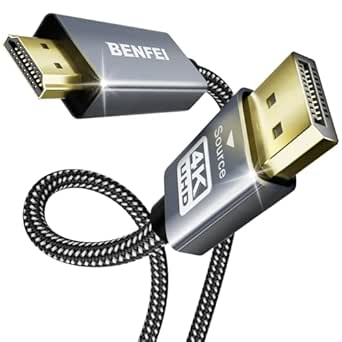
Choosing a DisplayPort 2.1 Cable: What 16K/8K Gaming and Productivity Really Requires
This specific 2-meter DisplayPort 2.1 cable promises the full 40Gbps bandwidth needed for emerging 16K@60Hz and 8K@120Hz displays, but achieving these specs depends on more than just the cable itself. Buyers should understand that a cable's certification, build quality, and compatibility with their specific GPU and monitor combination are critical for realizing the advertised 4K@240Hz or 2K@240Hz refresh rates.
Key Considerations Before Buying
- Verify your source (GPU) and display (monitor/TV) both support DisplayPort 2.1 UHBR (Ultra High Bit Rate) standards; otherwise, you're paying for future-proofing you cannot currently use.
- The 2-meter length is ideal for desktop setups but approaches the limit for reliable 40Gbps signaling; shorter cables often have more margin for error with high refresh rates.
- For the advertised 4K@240Hz, ensure your gaming monitor's specific model supports this refresh rate over DisplayPort, not just HDMI, as panel capabilities vary.
What Our Analysts Recommend
Look for explicit mention of VESA certification for DisplayPort 2.1 UHBR20 or UHBR13.5, though many cables, including this one, may not list it. High-quality, shielded connectors with a robust, snag-free jacket are indicators of good construction meant to handle the high-frequency signals of 40Gbps data transfer without interference.
DisplayPort Cables Market Context
Market Overview
The DisplayPort 2.1 cable market is currently bifurcated between certified, often premium-priced options and more affordable 'spec-compliant' cables like this one that claim the same bandwidth. True 16K and 8K@120Hz sources (like AMD's RDNA 3 and Intel's Arc GPUs) are still rare, making most purchases about future-proofing or maximizing 4K high-refresh-rate gaming today.
Common Issues
The most frequent issues are handshake failures (no signal), failure to achieve the highest advertised refresh rates, and intermittent flickering, often stemming from inadequate shielding, poor connector pins, or incompatible DP versions between devices. Many problems are misattributed to the cable when the source or display is the bottleneck.
Quality Indicators
Beyond basic specs, quality is shown in user reviews mentioning stable performance at 4K@144Hz/165Hz and above over time. Cables that maintain a tight, secure connection without sagging at the port and use full-size, latching DisplayPort connectors (not mini-DP) tend to be more reliable for permanent setups.
Review Authenticity Insights
Grade B Interpretation
A Grade 'B' with a 15% estimated fake review rate suggests the majority of feedback is trustworthy, but there is a moderate level of potentially inauthentic praise. The adjusted rating of 4.20/5 (down from 4.56/5) is a more realistic performance indicator, still pointing to a well-received product.
Trust Recommendation
Focus on the verified purchase reviews that detail specific use cases, like pairing with an RTX 4090 at 4K@144Hz or an AMD 7900 XTX. Be skeptical of reviews that only generically praise 'great quality' without mentioning resolution, refresh rate, or hardware tested.
Tips for Reading Reviews
Prioritize reviews that confirm the cable works with specific high-demand setups (e.g., 'achieved 4K@165Hz on my LG OLED') and note the GPU model. Look for reviews mentioning long-term use (3+ months) to assess durability, which is crucial for a cable constantly plugged and unplugged.
Expert Perspective
Based on the analysis, this is a competent 'spec-compliant' DisplayPort 2.1 cable that delivers for most current high-end gaming and professional use cases, particularly at 4K high refresh rates. The strong verified purchase rating (4.20 adjusted) indicates it reliably meets core expectations. However, its ability to handle the full 40Gbps for 8K@120Hz remains largely untested by the average consumer due to a lack of compatible hardware, making that claim more aspirational for now.
Purchase Considerations
This cable represents strong value if you need a robust 2-meter cable for 4K@144Hz/165Hz/240Hz gaming today and want a conduit for future GPU upgrades. The primary consideration is whether your current system can utilize any of the DP 2.1 advantages over a high-quality DP 1.4 cable, which also supports 4K@144Hz via Display Stream Compression (DSC).
Comparing Alternatives
Shoppers should compare this with VESA-certified DP 2.1 cables, which offer guaranteed performance but at a higher price point, and established DP 1.4 cables if their monitor's maximum refresh rate is within that standard's limits.