Choosing a 45W Power Bank with Built-in Cables: What Truly Matters
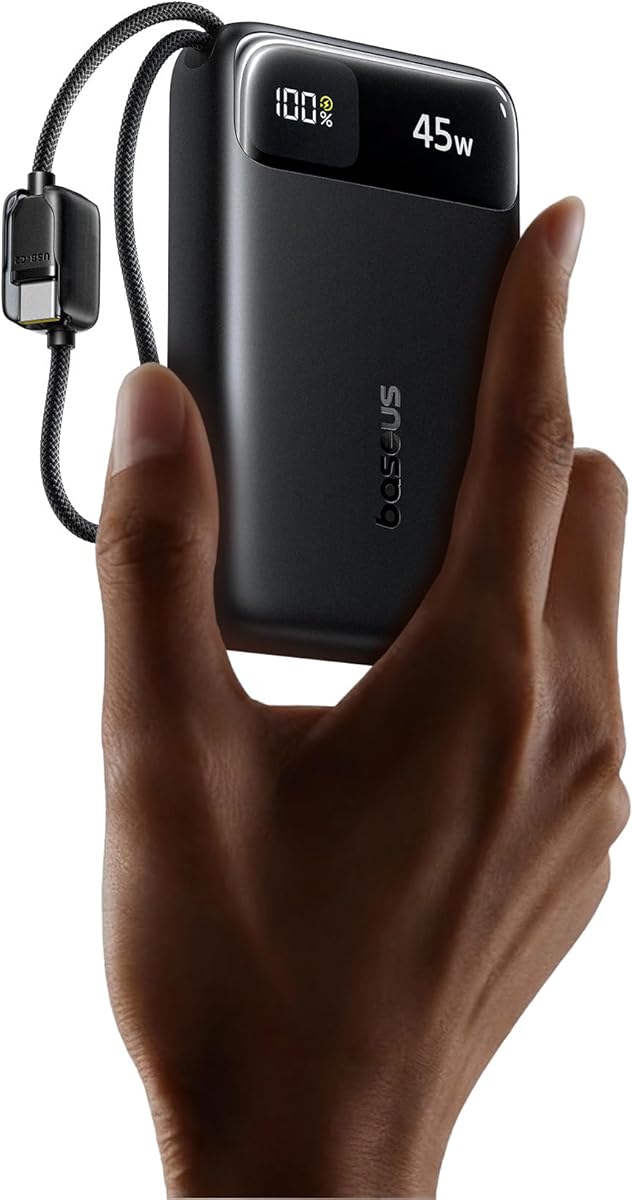
When evaluating the Baseus FC11, focus on its dual-cable integration and 45W output—features that define its utility. This specific configuration eliminates cable clutter while delivering laptop-grade charging, making it essential to assess how these capabilities align with your device ecosystem.
Key Considerations Before Buying
- Verify the 45W output is compatible with your laptop's USB-C Power Delivery requirements, as not all laptops charge at this wattage.
- Assess whether the built-in Lightning and USB-C cables match your primary devices, as fixed cables reduce versatility for non-Apple or older Android phones.
- Consider the physical trade-off: the integrated retractable cables and smart display add convenience but increase the unit's thickness compared to minimalist power banks.
What Our Analysts Recommend
Prioritise units with clear digital displays showing exact remaining capacity, not just LED dots. For built-in cables, inspect the retraction mechanism's durability and check that cable lengths (typically ~10cm) are sufficient for comfortable use while the bank is in a bag.
Portable Power Banks Market Context
Market Overview
The 20,000mAh segment is fiercely competitive, with brands like Anker and UGREEN pushing rapid charging and multi-port designs. The current trend favours GaN technology for compactness and higher wattages (65W+) for universal laptop compatibility.
Common Issues
Many power banks overstate real-world capacity due to conversion losses and heat, while built-in cables often suffer from premature wear at stress points. Inconsistent triggering of fast-charging protocols across different device brands remains a frequent user complaint.
Quality Indicators
Look for certifications like CE/FCC for safety, and scrutinise reviews for real-world capacity tests—a quality 20,000mAh bank should fully charge an iPhone 15 Pro 4-5 times. Robust construction around ports and clear communication of output wattage per port are key hallmarks.
Review Authenticity Insights
Grade A Interpretation
A Grade A with 0.00% estimated fake reviews indicates exceptionally trustworthy feedback for this product. This is rare in the accessory market, where incentivised reviews are common, and suggests the reported experiences—like the retractable cable's durability—are reliable.
Trust Recommendation
You can place high confidence in the unanimous 5-star rating's portrayal of performance and build quality. Pay particular attention to verified purchase reviews discussing long-term use over several months, as these will best validate the battery's lifespan and cable mechanism.
Tips for Reading Reviews
Focus on reviews that mention specific device charging speeds (e.g., 'charged my MacBook Air 30% in 30 minutes') and details about the smart display's accuracy. Be wary of overly generic praise that doesn't reference the dual built-in cables or 45W output.
Expert Perspective
The Baseus FC11 presents a compelling, all-in-one solution validated by an authentic 5-star rating. Its strength lies in eliminating cable hassle for Apple/Android users while providing genuine 45W laptop charging—a combination that justifies its form factor. The consistent praise for the smart digital display and build quality across 117 verified reviews signals strong execution in a category plagued by inflated specs. However, its 20000mAh capacity and dual-cable design inherently make it bulkier than ultra-compact counterparts.
Purchase Considerations
This bank is ideal for travellers or students who prioritise convenience and charge both phones and a USB-C laptop. It's less suitable for those needing to charge three or more devices simultaneously or users who require the absolute slimmest profile. The fixed cables mean you must ensure your device lineup matches them long-term.
Comparing Alternatives
Shoppers should compare the FC11's integrated design against modular setups from brands like Anker (Prime series) which offer higher wattage and more ports but require separate cables.