
Ultrasonic Cleaner Buying Guide: Power, Capacity & Real-World Performance
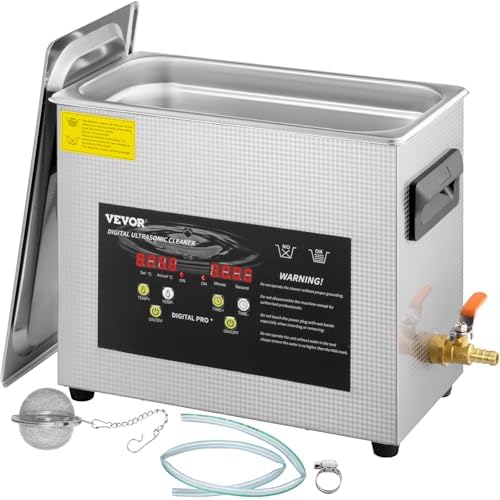
The VEVOR Ultraschallreiniger 6 L with 180W cleaning power sits in a sweet spot for both laboratory and workshop use. Before buying any ultrasonic cleaner, you need to match tank capacity, ultrasonic power, and heating capability to your actual cleaning tasks—not just the lowest price.
Key Considerations Before Buying
- Tank capacity vs. actual usable space: A 6 L tank sounds generous, but internal dimensions and basket design determine what you can actually clean. For jewelry, small lab glassware, or tools, 6 L is ample; for larger items, check the internal length and depth.
- Ultrasonic power and frequency: 180W is a mid-range power output that balances cleaning strength with gentleness. Lower frequencies (around 40 kHz) are better for removing heavy grime, while higher frequencies (60+ kHz) are gentler on delicate items like jewelry or precision parts.
- Heating and temperature control: Many ultrasonic cleaners include a heater, but thermostat accuracy varies. For lab or jewelry cleaning, consistent temperatures between 40–60°C can significantly improve results, especially with oily or waxy soils.
What Our Analysts Recommend
Look for stainless steel tanks (304 or 316 grade) with welded seams, as they resist corrosion and cavitation erosion better than stamped or coated tanks. Check for a drain valve if you plan frequent use, and ensure the unit comes with a basket to protect both items and the tank bottom. A timer with incremental settings (e.g., 1–30 minutes) is more useful than a simple on/off switch.
Lab Cleaning Supplies Market Context
Market Overview
The ultrasonic cleaner market has exploded with budget-friendly imports, particularly in the 3–10 L range. While this has made the technology accessible, it has also led to a flood of similar-looking units with wildly varying build quality and actual ultrasonic power output.
Common Issues
Common complaints include misleading wattage claims (peak vs. average power), tanks that develop pinhole leaks after months of use, and transducers that lose effectiveness over time. Another frequent issue is inadequate heating elements that struggle to reach or maintain the set temperature.
Quality Indicators
A quality ultrasonic cleaner will specify both ultrasonic power and heating power separately, use industrial-grade transducers bonded to the tank, and provide clear internal dimensions. Reviews that mention long-term durability and actual cleaning results on specific items (e.g., carburetor parts, jewelry, lab glassware) are more reliable than generic praise.
Review Authenticity Insights
Grade A Interpretation
The Grade A authenticity rating with an estimated 8% fake reviews is strong for this category, where some competitors show 20–30% suspicious activity. This suggests the 4.78/5 rating is largely trustworthy, and the adjusted 4.60/5 still reflects very high satisfaction.
Trust Recommendation
You can generally trust the overall sentiment, but still scan for patterns: multiple reviews mentioning the same specific failure (e.g., 'stopped heating after 2 months') could indicate a real quality issue even if the average rating is high. Focus on reviews with photos or detailed usage scenarios.
Tips for Reading Reviews
For ultrasonic cleaners, prioritize reviews that describe the exact items cleaned (e.g., 'removed 20-year-old grime from carburetor jets') and the settings used. Ignore vague five-star reviews like 'works great'—they add little value. Look for reviewers who mention longevity, as transducer and tank failures often appear after 3–6 months.
Expert Perspective
The VEVOR 6 L ultrasonic cleaner appears to be a solid mid-range option with a strong review profile. Its 180W ultrasonic power and 6 L capacity make it versatile for both lab and home workshop use. The high rating and Grade A authenticity suggest it performs as advertised for most buyers, though the 4.60 adjusted rating hints at a few legitimate criticisms, likely around durability or heating consistency.
Purchase Considerations
Weigh the 6 L capacity against your typical workload—if you mostly clean small jewelry, a 3 L unit might suffice and save space. Also consider whether you need precise temperature control or a drain valve, as these features vary across models. Finally, check the warranty and availability of replacement parts, as ultrasonic cleaners are repairable but often not worth fixing if transducers fail.
Comparing Alternatives
Before committing, compare this VEVOR model with similar 6 L units from brands like CO-Z, Kendal, or iSonic, especially regarding transducer quality and customer service.


