Buying a 50ft HDMI Cable? Here's What Actually Matters
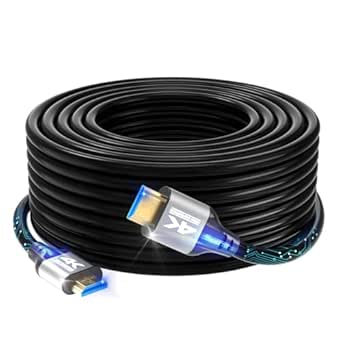
A 50-foot HDMI run is a different beast from the short cable in your TV box. The Cratree 8K Fiber Optic HDMI Cable uses optical fiber to carry 48Gbps over 15 meters—something copper cables struggle with—so understanding how fiber HDMI works will help you judge whether it fits your setup.
Key Considerations Before Buying
- Fiber optic HDMI cables are directional: the source end (often labeled 'TV' or 'Source') must plug into your device and the display end into your TV or projector. Reversing them is the most common reason a cable like this appears dead on arrival, so check the connector labels before assuming a defect.
- At 50 feet, cable routing and bend radius matter as much as specs. Fiber cables tolerate tight corners less well than copper, so plan a path with gentle bends and avoid stapling or crushing the cable during installation.
- Confirm your devices actually support the bandwidth you're paying for. 8K 60Hz and 4K 120Hz require compatible source and display hardware; if your projector or receiver tops out at 4K 60Hz, the cable will still work but you won't use its full capability.
What Our Analysts Recommend
Look for explicit HDMI 2.1 bandwidth claims (48Gbps), support for HDCP 2.2/2.3 and HDR10, and clear directional labeling on the connectors. A cable that lists these specifics—rather than vague '8K ready' claims—is more likely to deliver stable performance over long runs.
HDMI Cables Market Context
Market Overview
Long-distance HDMI has shifted toward fiber optic construction because copper cables become unreliable beyond roughly 25–30 feet at high bandwidth. The market is crowded with similar-looking fiber cables at widely varying prices, and certification claims are not always independently verified.
Common Issues
The most frequent complaints with long fiber HDMI cables are reversed installation, handshake failures with certain receivers or splitters, and intermittent signal dropouts when the cable is bent sharply. Buyers also sometimes expect features like eARC or CEC to work flawlessly over 50 feet, which isn't guaranteed by bandwidth alone.
Quality Indicators
Quality fiber HDMI cables use clearly marked source/display ends, robust connector housings, and specify HDCP versions and refresh rates rather than just resolution. Build quality at the connectors and strain relief matters more than cable thickness, since the fiber itself is thin and fragile.
Review Authenticity Insights
Grade A Interpretation
A Grade A authenticity rating with an estimated 8% fake review rate is strong for this category—it means the 4.67/5 average (4.50 adjusted) is largely built on genuine buyer experiences. The adjusted score barely moves, suggesting the suspicious reviews aren't inflating the rating meaningfully.
Trust Recommendation
You can treat the review base as broadly trustworthy, but still prioritize reviews that mention your specific use case—projector, receiver passthrough, or gaming at 4K 120Hz—since experiences vary by equipment. Treat short five-star reviews with no setup details as low-information.
Tips for Reading Reviews
For long HDMI cables, search reviews for words like 'flicker,' 'handshake,' 'directional,' and 'dropout' to surface real-world reliability reports. Reviews that describe the full chain (source, cable length, display) are far more useful than star ratings alone.
Expert Perspective
The Cratree 50FT fiber HDMI cable targets a genuine need: reliable 48Gbps signal transport over a distance where copper fails. Its strong, largely authentic review base and full spec sheet (8K 60Hz, 4K 120Hz, HDCP 2.2/2.3, HDR10) suggest it performs as advertised for typical home theater and projector installations, provided it's installed in the correct direction.
Purchase Considerations
Weigh whether your source and display can use the full bandwidth, whether your cable route allows gentle bends, and whether you need features like eARC that depend on device compatibility as much as the cable. If your run is under 25 feet, a quality copper cable may be simpler and cheaper.
Comparing Alternatives
Compare with other fiber HDMI cables in the 50-foot range, checking for certified Ultra High Speed labeling and return policies, since installation issues are the main reason long cables get returned.