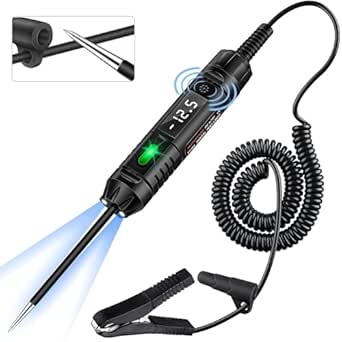
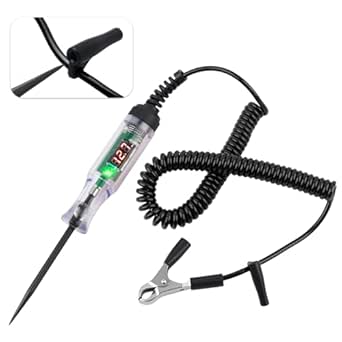
![POWER PROBE III Circuit Tester w/ Lead Set Kit (PP3LS01) [Car Diagnostic Test Tool, Digital Voltmeter, Supplies Power or Ground, Continuity Tester]](https://m.media-amazon.com/images/I/510+zsVc26L._AC_SL1200_.jpg)
Choosing a Professional-Grade Circuit Tester for Automotive Electrical Diagnostics
The POWER PROBE III isn't just a basic test light; it's an integrated diagnostic system that supplies power, ground, and reads voltage digitally. Buyers should understand this tool bridges the gap between a simple voltmeter and a full scan tool, specifically designed for tracing faults in 12V automotive and marine systems. Its ability to power components directly makes it unique for testing solenoids, relays, and lights on the bench or in the vehicle.
Key Considerations Before Buying
- Consider your diagnostic workflow: The PP3's core function is active circuit testing—applying power or ground on command—which is fundamentally different from passive multimeters and requires understanding circuit protection to avoid damage.
- Evaluate accessory needs: The included lead set kit with alligator clips and piercing probes is essential for real-world use; cheaper models often require separate purchases for equivalent functionality.
- Assess durability requirements: Professional mechanics praise its ruggedness for shop use, but occasional DIYers might find its premium construction and price point more robust than necessary for simple battery checks.
What Our Analysts Recommend
High-quality circuit testers feature bright, directional LED indicators for use in dark engine bays, fused protection for user and vehicle safety, and sharp, insulated piercing probes for accessing sealed wiring. The POWER PROBE III's digital voltage display with tenth-of-a-volt precision is a key differentiator from analog competitors, providing actionable data for diagnosing voltage drop issues.
Circuit Testers Market Context
Market Overview
The automotive circuit tester market is polarized between basic sub-$20 test lights and professional integrated systems like the POWER PROBE III, which retails for over $100. Recent trends show increasing integration of digital displays and powered testing capabilities even in mid-range tools, as vehicles use more complex body control modules and CAN bus systems.
Common Issues
Common problems include fragile leads that break at the strain relief, dim incandescent bulbs that are invisible in daylight, and lack of reverse polarity protection that can damage the tool or vehicle electronics. Many cheaper testers also lack the current capacity to reliably power components like fuel pump relays during diagnosis.
Quality Indicators
Look for tools with a high IP rating for dust/water resistance, gold-plated probe tips for consistent conductivity, and a robust warranty from a known brand in automotive diagnostics. The PP3's solid metal housing and sealed switch are tangible indicators of its professional-grade construction meant to withstand shop environments.
Review Authenticity Insights
Grade B Interpretation
A Grade B authenticity rating with a 10% estimated fake review rate suggests the vast majority of feedback is trustworthy, though shoppers should be aware that approximately 1 in 10 reviews may be inauthentic. The minimal drop from 4.89 to 4.60 after adjustment indicates the core rating is resilient and not heavily inflated by manipulation.
Trust Recommendation
Focus on the 90% of reviews deemed authentic, particularly those from verified purchasers detailing specific diagnostic scenarios like 'testing a blower motor resistor' or 'finding a broken wire in a trailer harness.' Be slightly more critical of overly generic 5-star reviews that lack technical details about actual use cases.
Tips for Reading Reviews
For technical tools like this, prioritize reviews that mention specific vehicle makes, electrical problems solved, or compare functionality to a multimeter or basic test light. Professional mechanic reviews often provide the most insightful commentary on durability and time saved in complex diagnostics.
Expert Perspective
The POWER PROBE III represents a specialized, professional-tier tool whose exceptional 4.6/5 adjusted rating is earned through robust performance in demanding shop environments. Its high score is driven by specific praise for its ability to quickly isolate opens, shorts, and bad grounds—tasks that are tedious with a standard multimeter. The consistency of reviews mentioning years of reliable service suggests this isn't a tool that fails after light use, justifying its premium position in the market.
Purchase Considerations
Weigh the frequency of your automotive electrical work against the investment; this tool excels for those regularly diagnosing parasitic draws, intermittent faults, or complex lighting systems. For simple battery or alternator checks, a basic multimeter may suffice, but for systematic circuit verification, the PP3's active testing capability is a significant time-saver.
Comparing Alternatives
Shoppers should compare the PP3's integrated system against purchasing a quality multimeter and separate power supply, considering both cost and convenience for their specific diagnostic needs.