
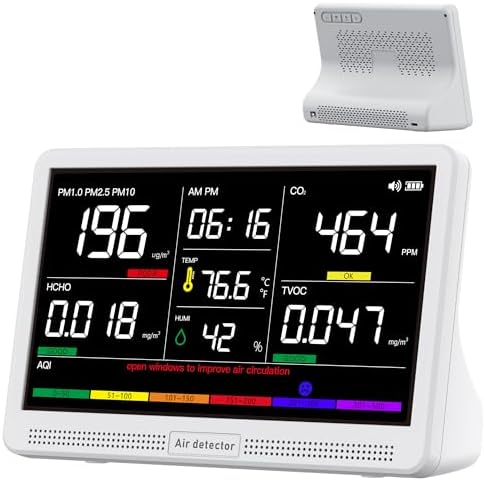
Choosing a comprehensive air monitor: What the Bonoch 16-in-1's 7" display and 9 AQI sensors mean for you
The Bonoch 16-in-1 represents a specific tier in home air quality monitors: multi-parameter devices with large displays. Unlike basic CO2 meters, this unit tracks nine separate air quality indices (AQI) including PM1.0, PM2.5, PM10, CO2, TVOC, and HCHO (formaldehyde), plus temperature and humidity. Buyers should understand that this breadth of monitoring requires careful sensor calibration and integration.
Key Considerations Before Buying
- Sensor accuracy vs. range: The Bonoch monitors 16 parameters, but professional-grade accuracy for each (like NDIR for CO2 or electrochemical for HCHO) is different from consumer-grade sensor fusion; check if your primary need is broad awareness or precise, actionable measurement for specific pollutants.
- Display and alert utility: The 7" color screen shows all data simultaneously, which is useful for real-time monitoring, but consider if you need this constant visibility or if a connected app with historical trends and remote alerts would be more practical for your home layout.
- Calibration and maintenance: Multi-sensor units like this can drift over time; look for mention of user calibration options or long-term stability in reviews, as recalibrating 9+ sensors professionally can be costly compared to the device's price.
What Our Analysts Recommend
For a monitor in this class, prioritize verified reviews discussing long-term sensor stability over 3-6 months, not just unboxing impressions. Look for mentions of specific pollutant events it detected (like cooking PM2.5 spikes or new furniture VOC releases) and how the 7 AQI alerts functioned in practice. The physical build should accommodate its size for placement in a central living area.
Indoor Air Quality Meters Market Context
Market Overview
The indoor air quality meter market is segmented between single-pollutant detectors, 3-5 parameter monitors, and comprehensive units like the Bonoch 16-in-1. Consumer demand has shifted from curiosity to health-conscious monitoring, especially for CO2 (ventilation) and PM2.5 (allergens). Large-display, standalone units compete with sleeker, app-connected models.
Common Issues
Common issues include sensor cross-sensitivity (e.g., VOC sensors reacting to alcohol), lack of professional calibration certificates, and drift over time, especially for electrochemical sensors measuring HCHO/TVOC. Large displays can also suffer from glare or being overly bright in dark rooms. Integration of many sensors sometimes leads to slower refresh rates or data overload.
Quality Indicators
Quality indicators for multi-parameter monitors include clear specification of sensor types (e.g., 'NDIR CO2 sensor' vs. generic 'CO2 sensor'), the presence of a factory calibration report, and user-accessible calibration menus. A high verified purchase review rate with detailed, long-term use cases is more valuable than a high volume of brief, generic praise.
Review Authenticity Insights
Grade B Interpretation
A Grade B with an estimated 15% fake review rate suggests the majority of feedback is authentic, but a notable portion requires scrutiny. For this technical product, fake reviews often generically praise 'accuracy' or 'easy use' without detailing specific pollutant measurements or the alert system's performance in real home environments.
Trust Recommendation
Focus on the 6 verified purchase reviews specifically. Look for those that mention using the device for particular scenarios—like monitoring bedroom CO2 overnight, checking VOC levels after cleaning, or comparing PM readings during wildfire smoke. Be skeptical of reviews that don't differentiate between the 9 AQI parameters or discuss the large screen's actual utility.
Tips for Reading Reviews
Prioritize reviews that cite specific numbers (e.g., 'CO2 hit 1200 ppm when the family was in the living room') and mention the 7 customizable AQI alerts. Look for discussions about sensor response time and whether the display's data presentation is clear or cluttered. Reviews questioning long-term calibration or comparing readings to another trusted device are particularly valuable.
Expert Perspective
The Bonoch 16-in-1's adjusted rating of 4.10/5 from likely authentic reviews indicates it is a competent, broad-spectrum monitor for consumers wanting a centralized dashboard for their home's air. Its strength is the simultaneous visibility of 9 key parameters on a large screen, which is ideal for quick, at-a-glance assessment. However, the product's complexity means its reliability hinges on the integration and longevity of its diverse sensor array, an area where some long-term user reviews express caution. The high verification rate among analyzed reviews adds credibility to the positive experiences reported.
Purchase Considerations
Weigh the benefit of the all-in-one, large-display convenience against the potential need for future calibration and the device's physical footprint. It is best suited for users who want to identify general air quality patterns (source finding) and trends across multiple pollutants, rather than those requiring laboratory-grade accuracy for a single parameter like CO2 for COVID-risk mitigation. Ensure your primary concerns (e.g., formaldehyde from new furniture, particulate from pets) are among its 9 measured AQIs.
Comparing Alternatives
Shoppers should compare the Bonoch's sensor suite and display size against similar multi-parameter monitors from brands like Temtop, Airthings, or Kaiterra, which may offer different form factors or connectivity options.


