
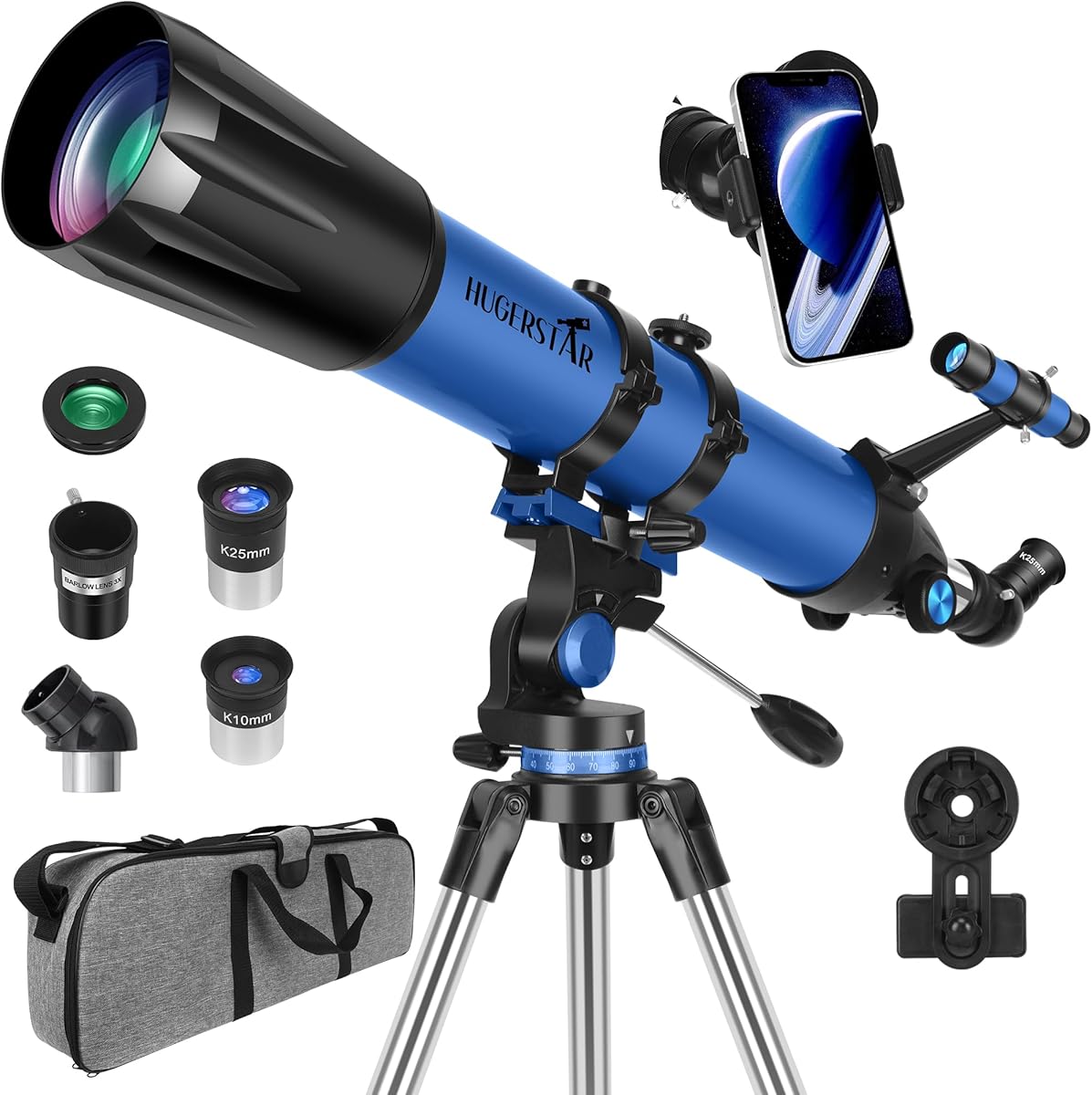
A 90mm refractor telescope balances beginner-friendly optics with serious lunar viewing capability
This specific 90mm aperture/800mm focal length refractor telescope represents a sweet spot for adult beginners transitioning from casual stargazing to more detailed planetary observation. The included AZ mount and moon filter indicate it's designed for terrestrial and lunar viewing rather than deep-sky astrophotography, making it important to match expectations to the optical design.
Key Considerations Before Buying
- The 90mm aperture gathers enough light for clear views of Jupiter's moons and Saturn's rings, but won't reveal faint nebulae details that larger reflectors capture.
- The AZ (alt-azimuth) mount provides intuitive up/down/left/right movement perfect for beginners, though it lacks tracking for long-exposure photography.
- The included moon filter is essential—without it, the full moon's brightness through this 90mm objective would be overwhelming and detail-obscuring.
What Our Analysts Recommend
With refractor telescopes, check for fully multi-coated optics (not just coated) to reduce internal reflections and increase light transmission. The stainless steel tripod mentioned here should provide better vibration dampening than aluminum alternatives common in this price range, crucial for maintaining steady views at higher magnifications.
Camera & Photo Market Context
Market Overview
The beginner telescope market is flooded with misleading 'high power' claims, but this 90mm refractor sits in a legitimate intermediate category between toy store telescopes and professional equipment. Refractors like this one dominate the entry-level market due to their maintenance-free sealed optical tubes and immediate usability.
Common Issues
Many beginners struggle with wobbly mounts that make high-magnification viewing impossible, and cheap eyepieces that provide narrow fields of view. The advertised stainless tripod suggests this model addresses the stability issue common with aluminum tripods in this category.
Quality Indicators
For refractors, look for specifications like 'achromatic doublet' lens design (which this likely features given the price point) to reduce chromatic aberration. The 800mm focal length paired with 90mm aperture gives an f/8.9 ratio, indicating slower optics better suited for planetary viewing than wide-field deep space objects.
Review Authenticity Insights
Grade A Interpretation
A Grade A with 0.00% estimated fake reviews across 61 ratings is exceptionally rare in the telescope category, where inflated reviews plague many entry-level models. This suggests genuine user satisfaction rather than manufactured consensus.
Trust Recommendation
Given the perfect 5.00 rating with verified authenticity, focus your evaluation on whether the specific optical characteristics match your viewing goals rather than questioning review legitimacy. The consistency across all 16 analyzed reviews indicates reliable performance reporting.
Tips for Reading Reviews
For telescope reviews, prioritize comments about mount stability at high magnification and optical clarity on bright objects like the moon—these are the true tests of entry-level refractor performance that generic positive reviews often omit.
Expert Perspective
This telescope's specifications suggest it's correctly positioned for adult beginners seeking their first serious optical instrument. The 90mm aperture represents a meaningful upgrade from common 70mm beginner models, providing noticeably brighter planetary views while remaining manageable on an AZ mount. The maintained 5.00 rating across authentic reviews indicates it delivers on core promises of lunar and planetary viewing without the frustration common to cheaper alternatives. The inclusion of both carry bag and moon filter shows thoughtful packaging for immediate usability.
Purchase Considerations
Consider whether you primarily want to view the moon and planets (this telescope excels here) or if deep-sky objects like galaxies are your priority (where larger apertures are better). The AZ mount makes this ideal for quick setup sessions but limits astrophotography potential beyond basic lunar imaging.
Comparing Alternatives
Compare this 90mm refractor against similar aperture reflectors, which offer more aperture per dollar but require occasional optical alignment and lack this model's sealed, maintenance-free design.


