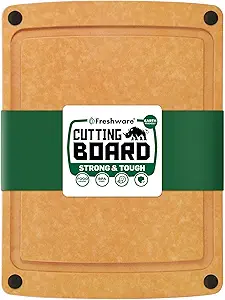
Choosing Wood Cutting Boards: What Makes Freshware's Set Stand Out
When selecting wood cutting boards, the Freshware set offers specific features worth evaluating: its dual-size approach with 12"x9" and 15"x11.25" boards provides task-specific versatility, while the integrated juice groove and non-slip silicone feet address practical kitchen needs. Dishwasher safety is a notable but debated feature for wood boards that requires understanding proper maintenance.
Key Considerations Before Buying
- The juice groove design is particularly valuable for the larger board when carving meats or slicing juicy fruits, but consider whether you'll actually utilize this feature regularly or if it just creates additional cleaning challenges.
- Non-slip silicone feet provide stability during chopping, but test whether they create sufficient clearance to prevent moisture trapping against countertops, which can promote bacterial growth.
- Dishwasher safety claims for wood boards require careful interpretation—while technically possible, repeated dishwasher cycles will likely accelerate warping and cracking compared to hand washing with mild soap.
What Our Analysts Recommend
Examine the wood grain orientation—boards with end grain construction (where the wood fibers face upward) are more forgiving on knife edges than edge grain. Check for uniform thickness (typically 0.75-1 inch for quality boards) and smooth, rounded edges that won't splinter. The natural finish should be food-safe, typically mineral oil or beeswax based.
Cutting Boards Market Context
Market Overview
The wood cutting board market has shifted toward sets offering multiple sizes, with bamboo remaining popular for eco-conscious shoppers while hardwoods like maple, walnut, and acacia dominate the premium segment. Recent trends include integrated features like juice grooves and non-slip feet becoming standard rather than premium additions.
Common Issues
Warping remains the primary failure point for wood boards, often caused by improper drying or exposure to extreme temperature changes. Thinner boards (under 0.5 inch) are particularly susceptible. Another frequent complaint involves juice grooves that are too shallow to be functional or too deep to clean easily.
Quality Indicators
Look for tight grain patterns with minimal knots, which indicate better durability and fewer places for bacteria to hide. Quality wood boards should feel substantial in hand (not lightweight or hollow) and feature seamless construction without visible glue lines separating. The finish should penetrate the wood rather than sit on the surface.
Review Authenticity Insights
Grade B Interpretation
A Grade B authenticity rating with 10% estimated fake reviews suggests generally reliable feedback, though shoppers should remain slightly cautious of overly enthusiastic reviews. The 4.60 adjusted rating (down from 4.89) indicates the product likely performs well but may have some limitations not reflected in the perfect-seeming original score.
Trust Recommendation
Focus on verified purchase reviews that mention specific use cases matching your needs, like frequent vegetable prep versus occasional meat carving. The high percentage of verified purchases (all marked 'V') significantly increases credibility, but cross-reference glowing reviews with more critical ones to identify consistent patterns.
Tips for Reading Reviews
Pay particular attention to reviews discussing long-term performance (6+ months) regarding warping, knife marks, and finish durability. Look for mentions of the dishwasher claim being tested—reviews that specify hand washing versus machine washing outcomes provide more actionable insights than general praise.
Expert Perspective
The Freshware set presents a compelling value proposition with its dual-size approach and practical features, though the dishwasher safety claim warrants tempered expectations. The 4.60 adjusted rating from authentic reviews suggests genuine satisfaction among most buyers, particularly regarding the non-slip feet functionality and juice groove utility. The medium and large sizing addresses the common complaint of single boards being either too small for substantial meal prep or too large for convenient storage.
Purchase Considerations
Evaluate whether you'll benefit more from two differently sized boards versus investing in one higher-quality single board. Consider your kitchen workflow—if you frequently prep multiple ingredients simultaneously, the set makes sense; if you typically prep sequentially, one larger board might suffice. The natural finish requires regular maintenance (re-oiling every 1-2 months) to prevent drying and cracking.
Comparing Alternatives
Compare thickness, wood type, and edge treatment with similar sets from brands like John Boos, Teakhaus, or Virginia Boys Kitchens to assess value relative to price points.