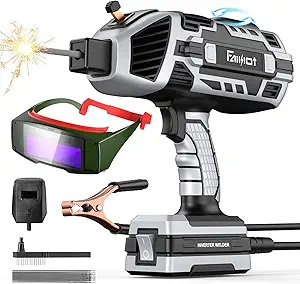
Choosing a 110V Portable IGBT Inverter Welder: Power, Portability, and Practicality
The Saker welder represents a specific class of entry-level, home-shop equipment: the 110V portable IGBT inverter. Buyers should understand this machine is designed for light-duty fabrication, repair, and hobbyist projects using standard 3/32" rods, not for continuous industrial use. Its core value proposition is its plug-and-play capability on standard household current, eliminating the need for 220V circuits.
Key Considerations Before Buying
- Assess your power source: This 110V welder is ideal for garages or home shops with standard outlets, but its output is inherently limited compared to 220V models; ensure your circuit can handle the ~20-amp draw at higher settings.
- Match the duty cycle to your workflow: Portable inverters like the Saker have limited duty cycles (the percentage of a 10-minute period it can weld continuously); for intermittent tack welds and short beads on thin gauge metal, it's sufficient, but not for long, continuous seams.
- Verify consumable compatibility: The machine is specified for 3/32" (2.4mm) electrodes; using larger rods will overload the inverter, while smaller rods may not strike an arc reliably at the machine's minimum current setting.
- Evaluate true portability: While handheld, consider the total package weight with cables and the need for a compatible power source within 50 feet, as extension cords can cause voltage drop and poor performance.
What Our Analysts Recommend
For IGBT inverters, key quality indicators include a robust, fan-cooled metal housing for heat dissipation and smooth, click-adjustable current dials—not flimsy plastic switches. The welding cable connections should be solid and secure, not prone to loosening, as a poor connection creates resistance and heat, damaging the unit. A well-designed arc force control (often called "hot start") is crucial for easy arc striking, a common pain point in budget welders.
Welding Systems Market Context
Market Overview
The market for sub-$200 110V inverter welders is crowded, with many units sharing similar Chinese-made IGBT cores but varying wildly in build quality, accessory inclusion, and safety features. These machines have democratized basic arc welding for DIYers, but performance and durability are not uniform across brands.
Common Issues
Common failures in this category include overheating and thermal shutdown during extended use, fragile plastic current selectors that break, and poor-quality electrode holders that overheat or fail to grip rods securely. Another frequent complaint is vague or inaccurate current markings, making it difficult to dial in the correct heat for specific metal thicknesses.
Quality Indicators
Look for units with genuine IGBT transistors (not older SCR technology) for efficiency, metal-bodied electrode holders, and copper-wound transformers. A higher duty cycle at the machine's rated output (e.g., 60% at 90A is better than 20% at 90A) indicates better thermal management and component quality. Quality machines also include clear, detailed manuals with welding charts for different electrodes.
Review Authenticity Insights
Grade B Interpretation
A 'B' grade with an estimated 15% fake review rate suggests the majority of feedback is trustworthy, but a notable portion of reviews may be inflated. The adjusted rating of 4.50/5 (down from 4.87/5) is a more realistic performance indicator, still representing a well-regarded product in its class.
Trust Recommendation
Prioritize reading the verified purchase (V) reviews, which constitute a strong sample here, and pay particular attention to mid-range 3- and 4-star reviews. These often contain the most balanced, specific critiques about real-world limitations, such as duty cycle constraints or accessory quality, that 5-star reviews may gloss over.
Tips for Reading Reviews
For technical tools like welders, seek out reviews that mention specific use cases (e.g., 'welded 16-gauge steel trailer fender' or 'used E6013 rods'), metal thicknesses, and runtime before overheating. Be skeptical of reviews that only praise packaging or delivery speed without detailing performance, or those using identical generic phrasing across multiple products.
Expert Perspective
The Saker welder's high adjusted rating of 4.50/5, backed by a solid base of authentic reviews, indicates it performs reliably within its designed niche of light-duty, 110V arc welding. The inclusion of an IGBT inverter is a positive sign for efficiency and arc stability compared to older transformer-based portables. However, its performance ceiling is defined by its power input; it is a tool for specific, intermittent tasks, not a primary fabrication machine. The positive feedback likely stems from it meeting or exceeding low-cost expectations for hobbyist use.
Purchase Considerations
Purchase this if your needs align with occasional repair jobs on materials up to 1/8" thick, you only have 110V power, and value extreme portability. Hesitate if you plan to weld daily, need to join metal thicker than 3/16", or require precise TIG-like control, as the basic arc process can be challenging on very thin sheet metal. The duty cycle will be your primary limiting factor.
Comparing Alternatives
Shoppers should compare the Saker's duty cycle specifications, accessory quality (especially the electrode holder), and warranty terms against similar models from brands like YesWelder, Forney, and Hobart's Stickmate series for similar budgets.