
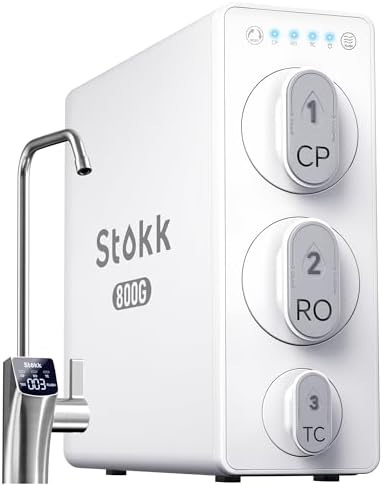
Evaluating High-Capacity Tankless RO Systems: What the Stokk 800 GPD Offers
The Stokk 800 GPD tankless reverse osmosis system represents a modern approach to under-sink filtration, eliminating the storage tank entirely. With its 8-stage filtration and 3:1 waste ratio, this system prioritizes flow rate and contaminant reduction, specifically mentioning PFAS reduction capabilities. Buyers should understand how tankless operation differs from traditional RO systems in both installation and performance.
Key Considerations Before Buying
- The 800 GPD (gallons per day) flow rate is exceptionally high for residential use—consider whether your household truly needs this capacity or if a lower GPD system would suffice while potentially reducing water waste.
- NSF/ANSI 58&42 certifications indicate the system meets specific standards for total dissolved solids reduction (58) and aesthetic contaminant reduction (42), but verify which specific contaminants are certified rather than assuming all claims are certified.
- The 3:1 pure-to-drain ratio represents water efficiency—for every gallon of purified water, three gallons go to drain, which is better than older 4:1 or 5:1 systems but still creates significant wastewater.
What Our Analysts Recommend
For tankless RO systems, examine the pump specifications and membrane quality, as these components work harder without a storage tank. The smart faucet integration suggests digital monitoring capabilities—check what parameters it displays (TDS, filter life, flow rate) and whether it requires proprietary connections. Verify that PFAS reduction claims are backed by third-party testing data, not just marketing language.
Under-Sink & Countertop Filtration Market Context
Market Overview
The under-sink RO market has shifted toward tankless designs in recent years, addressing space constraints and stagnation concerns associated with storage tanks. High-GPD systems like this 800 GPD model compete with more moderate 400-600 GPD systems, often targeting larger households or users wanting near-instantaneous filtered water. Smart features have become increasingly common, though implementation quality varies significantly.
Common Issues
Tankless systems can experience pressure fluctuations if not properly sized for household water pressure, and the constant demand on components may lead to earlier pump failure compared to tank systems. High-GPD systems sometimes sacrifice some contaminant reduction efficiency for flow rate, though certifications help mitigate this concern. Smart faucet integrations frequently face connectivity issues or have limited app functionality.
Quality Indicators
Look for clearly stated NSF certifications with standard numbers (like 58 and 42 here), not vague 'NSF-tested' claims. Quality tankless systems use commercial-grade pumps and include pressure gauges or monitoring systems. Transparent specification of membrane type (likely a 800 GPD Dow Filmtec or equivalent) and filter cartridge dimensions indicates manufacturer confidence in their components.
Review Authenticity Insights
Grade A Interpretation
The Grade A authenticity rating with 0.00% estimated fake reviews means this product listing currently shows no signs of review manipulation—a positive signal in a category where some brands artificially inflate ratings. However, the 0.00/5 rating with zero reviews creates a complete information vacuum about real-world performance.
Trust Recommendation
With no existing reviews, you cannot rely on crowd-sourced feedback and must depend entirely on manufacturer specifications and certifications. Prioritize verifying the NSF certifications directly on the NSF website using the product's specific listing number. Request performance data sheets from the manufacturer regarding PFAS reduction claims before purchasing.
Tips for Reading Reviews
When reviews eventually appear, look for mentions of long-term pump reliability, actual flow rate measurements (not just 'fast'), and smart faucet functionality over 6+ months. Be skeptical of reviews discussing only unboxing or initial installation without addressing ongoing performance, as RO systems reveal their true quality through sustained operation.
Expert Perspective
The Stokk system presents a technically compelling specification sheet with its high flow rate, dual certifications, and explicit PFAS focus, but the complete absence of user feedback creates substantial uncertainty. The 8-stage design suggests comprehensive filtration, though some stages may be redundant marketing additions rather than functionally distinct. The tankless approach makes sense for users with space constraints or concerns about water stagnation in traditional RO tanks, but introduces different maintenance considerations. The smart faucet could provide valuable monitoring if implemented well, but could also become a point of failure if the electronics prove unreliable.
Purchase Considerations
Weigh whether your household actually benefits from 800 GPD—most families find 400-600 GPD sufficient even for simultaneous uses. Consider the wastewater implications of any RO system in your region, especially in drought-prone areas. Evaluate your willingness to be an early adopter without performance history versus choosing an established brand with documented reliability but potentially fewer features.
Comparing Alternatives
Compare this system's specifications against established tankless competitors like Waterdrop's G3 series or iSpring's tankless models, paying particular attention to certification details and component warranties.


