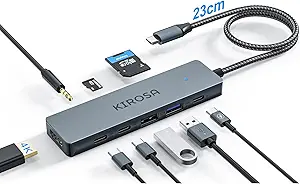
Choosing a Powered USB Hub: Why Port Specialization and Power Management Matter
The Wenter 6-Port Hub exemplifies a modern hybrid design, splitting ports between dedicated high-speed data transfer (4x USB 3.0) and dedicated Quick Charge 3.0 power delivery (2x 36W). This specialization prevents charging devices from bottlenecking data throughput, a key advantage over hubs with uniform ports. Buyers should evaluate if this specific 4+2 configuration matches their need to simultaneously connect peripherals like external drives and fast-charge phones or tablets.
Key Considerations Before Buying
- Assess your power needs: The included 5V/4A power adapter supports the two QC 3.0 ports, but ensure it provides enough total current for all six ports if you plan to run multiple high-draw devices simultaneously.
- Evaluate port control: Individual LED-lit on/off switches for each port, as featured here, allow you to power-cycle specific devices without unplugging them, which is invaluable for troubleshooting or managing peripherals like webcams or card readers.
- Consider connectivity chain: As a powered hub, this device draws its own power, preventing it from overloading your computer's USB controller. This is essential for connecting bus-powered hard drives or multiple accessories.
What Our Analysts Recommend
For a hub with charging ports, verify the supported fast-charging protocols (like QC 3.0 here) match your devices. Check that the power adapter's output (listed in volts and amps) is robust enough to support the hub's maximum rated power across all ports. Build quality indicators include secure port connections, a non-slip base, and sturdy, tangle-resistant cabling.
USB Hubs Market Context
Market Overview
The USB hub market is saturated with products that often overpromise on power delivery and data speed. Differentiated models like this Wenter hub, which clearly separates data and high-wattage charging functions, are becoming more common as users seek to declutter desks with single, capable solutions. The trend is moving beyond simple port multipliers to intelligent hubs with port-specific roles.
Common Issues
Common failures include underpowered adapters causing intermittent disconnections, poor heat dissipation leading to throttled speeds or hub failure, and cheap controllers that cannot sustain USB 3.0's full 5 Gbps bandwidth across multiple ports. Hubs that mix data and high-speed charging on the same ports often suffer from performance degradation.
Quality Indicators
Look for explicit specification of the controller chipset (though rarely listed), a solid metal or high-grade plastic casing for heat dissipation, and clear labeling of each port's capability. A high-quality powered hub will explicitly state its total power output and per-port power limits, unlike generic models.
Review Authenticity Insights
Grade B Interpretation
A 'Grade B' authenticity rating with an estimated 10% fake review rate suggests the vast majority of feedback is reliable, but a small portion of reviews may be inauthentic. The adjusted rating of 4.50/5 (down from 4.78/5) is still exceptionally strong for this category, indicating genuine high satisfaction.
Trust Recommendation
Focus on reviews that detail long-term use (3+ months), mention specific device combinations (e.g., 'charges my iPad Pro and Samsung S22 while transferring from two WD drives'), or note the performance of the individual power switches. Be slightly more skeptical of overly vague 5-star reviews that lack this specific usage context.
Tips for Reading Reviews
For technical products like hubs, prioritize reviews that discuss real-world data transfer speeds using specific file types or that test the QC 3.0 ports with a voltmeter. Reviews mentioning stable performance over weeks are more valuable than first-impression posts, as they speak to build quality and heat management.
Expert Perspective
The Wenter hub's data demonstrates a product that successfully executes a specific design philosophy: segregating data and high-power charging. The high authentic rating (4.50/5) strongly suggests it delivers on its core promises of stable data transfer and fast charging without cross-interference. The individual port switches are a premium feature typically found in more expensive models, adding significant practical value for power users. Its primary strength is its clear, dedicated port allocation, which solves a common pain point in mixed-use environments.
Purchase Considerations
This hub is an ideal fit for users with a clear split between data peripherals (external SSDs, card readers, dongles) and devices needing rapid charging. Consider your future needs; if you anticipate requiring more than four data ports, this configuration may become limiting. The need for a wall outlet for the power adapter is a trade-off for its stable, high-power output.
Comparing Alternatives
Shoppers should compare the per-port power specs and total adapter amperage with similar 6-port hybrid hubs from brands like Anker or Sabrent to ensure competitive performance.