Choosing a Portable Power Station: Balancing Capacity, Chemistry, and Charging Speed
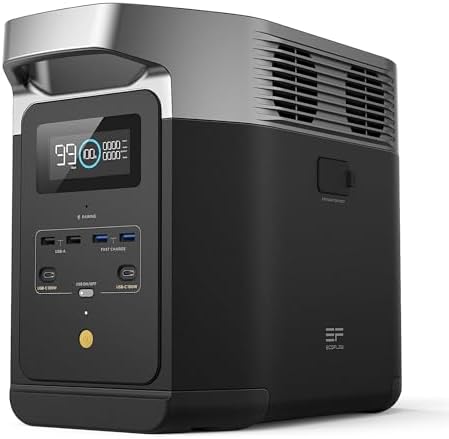
When evaluating the EcoFlow DELTA 2, focus on its specific 1024Wh LiFePO4 battery chemistry and 1800W AC output. This combination offers a different value proposition than traditional lead-acid or older lithium-ion generators, prioritizing longevity and safety over maximum energy density.
Key Considerations Before Buying
- The LiFePO4 (LFP) battery in the DELTA 2 provides 3,000+ charge cycles to 80% capacity, making it a long-term investment for frequent users like campers or for home backup, unlike standard NMC batteries that degrade faster.
- With 1800W AC output and a 2400W surge, verify it can start your specific devices; it will run a refrigerator but may struggle with high-startup-wattage tools like air compressors.
- The dual 100W USB-C ports support fast laptop charging, a key feature for remote workers, but note that simultaneously using high-wattage AC devices will drain the 1024Wh capacity faster than expected.
What Our Analysts Recommend
For solar compatibility, check the maximum solar input wattage (500W for the DELTA 2) and required panel voltage. Quality is indicated by a robust BMS (Battery Management System) that manages cell balancing and temperature, which EcoFlow integrates for the LFP cells.
Generators Market Context
Market Overview
The portable power station market is shifting from bulky, noisy gas generators to clean, modular lithium-based systems. The DELTA 2 sits in the competitive 1kWh capacity tier, where brands compete on battery chemistry, charging speed (EcoFlow's X-Stream tech offers 0-80% in 50 minutes), and ecosystem expansion with solar panels.
Common Issues
Buyers often underestimate real-world watt-hour consumption, leading to shorter runtime than advertised. Another frequent mismatch is between a unit's pure sine wave inverter quality and the sensitivity of medical or professional electronics, though the DELTA 2's pure sine wave is suitable for most.
Quality Indicators
Prioritize units with UL certification for safety, clear cycle life ratings for the battery (like the DELTA 2's LFP rating), and a responsive thermal management system. A quality unit will have detailed specs on pass-through charging capability and degradation warranties.
Review Authenticity Insights
Grade B Interpretation
A 'Grade B' with a 15% estimated fake review rate suggests a generally trustworthy review pool, but a notable portion of feedback requires scrutiny. For a tech-heavy product like this, fake reviews often generically praise 'power' or 'portability' without technical details.
Trust Recommendation
Prioritize verified purchase reviews that mention specific use-case runtimes (e.g., 'ran my 50W fridge for 18 hours') or discuss the LFP battery's performance over time. Be skeptical of reviews that don't address the trade-offs of the 1024Wh capacity.
Tips for Reading Reviews
Look for reviews that compare charging methods (AC, solar, car) and note the unit's behavior under 1500W+ sustained load. Authentic critical reviews often cite specific app connectivity issues or fan noise under high load, not just vague complaints.
Expert Perspective
The EcoFlow DELTA 2's strong adjusted rating of 4.3/5, derived from a largely authentic review pool, indicates it meets expectations for its core promises: fast charging and durable LFP chemistry. Its position is for users who value recharge speed and battery lifespan over the absolute maximum capacity per dollar. The optional solar integration is a significant value-add for off-grid scenarios, but the 1024Wh capacity is a hard limit for prolonged home backup.
Purchase Considerations
Choose this if your priority is a future-proof LFP battery for weekly use and rapid AC recharging. Consider a larger capacity unit or a gas generator if you need to power a sump pump and refrigerator simultaneously for multiple days during a blackout.
Comparing Alternatives
Shoppers should directly compare the DELTA 2's specs and LFP chemistry against similarly priced NMC battery units from Jackery or Bluetti, which might offer higher Wh ratings but fewer life cycles.