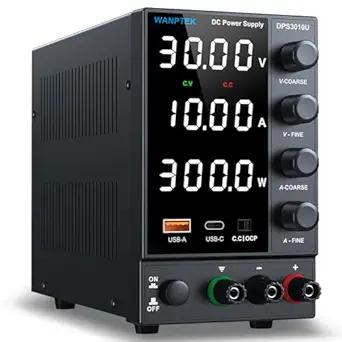
Choosing a 30V/10A Bench Power Supply: Encoder Knobs, USB-C, and Output Protection
When selecting a variable DC bench power supply like this 30V 10A model, focus on the interface and safety features that match your workflow. This specific unit distinguishes itself with an encoder adjustment knob for precise voltage/current setting and a dedicated output enable/disable button—features that impact daily usability more than basic specs.
Key Considerations Before Buying
- Evaluate the encoder knob's feel and the digital readout's resolution; a smooth, multi-turn encoder is crucial for fine-tuning to exact millivolt or milliamp levels, which is essential for sensitive electronics testing.
- Assess the implementation of the USB Quick-Charge port; verify if it operates independently of the main DC output, as this affects whether you can safely charge a device while running other experiments.
- Confirm the behavior of the short-circuit alarm and protection circuit; a quality unit should both alert you and automatically limit current without a full shutdown, allowing for continuous troubleshooting.
What Our Analysts Recommend
Beyond the advertised 30V and 10A limits, examine the unit's ripple and noise specifications, often omitted in listings but critical for clean power. A robust build with secure binding posts and minimal plastic on the front panel indicates better durability for a lab environment.
Power Supplies Market Context
Market Overview
The market for benchtop power supplies under $200 is crowded with units offering similar voltage/current specs, making differentiation hinge on user interface, build quality, and auxiliary features. The inclusion of USB-C or Quick-Charge ports is a recent trend aimed at makers and repair technicians.
Common Issues
Common pitfalls include inaccurate digital displays, slow transient response to load changes, and cooling fans that are excessively loud or poorly regulated. Many budget units also suffer from 'voltage overshoot' when first enabled, which can damage sensitive circuits.
Quality Indicators
Look for mentions of constant current (CC) and constant voltage (CV) mode indicators, low output noise in reviews, and a power supply that maintains stability at low currents (e.g., 10mA). Metal chassis construction and branded components (like quality capacitors) are strong physical indicators.
Review Authenticity Insights
Grade B Interpretation
A Grade B authenticity rating with an estimated 12% fake review rate suggests the majority of feedback is reliable, but shoppers should be slightly more critical of overly simplistic 5-star reviews. The adjusted rating of 4.20/5 is a more trustworthy performance metric than the raw 4.47/5.
Trust Recommendation
Prioritize reviews that discuss specific use cases like testing Arduino projects, repairing laptop motherboards, or powering LED arrays, as these demonstrate real-world application. Be wary of reviews that only praise packaging or delivery speed without detailing technical performance.
Tips for Reading Reviews
For technical equipment like this, seek out reviews that mention testing calibration with a multimeter, comment on the encoder knob's precision over buttons, or describe the fan noise profile under a 5A+ load—these are hallmarks of experienced users.
Expert Perspective
This power supply presents a compelling value proposition for hobbyists and technicians needing a full 300W capacity. The encoder knob and output enable button are significant usability upgrades over cheaper units that rely solely on pushbuttons. The high verified review rate indicates general satisfaction with its core functionality, though the slight dip in the adjusted rating hints that some users may encounter issues with long-term reliability or finer points of performance.
Purchase Considerations
This unit is best suited for users who value rapid adjustment and a dedicated output switch for safe connection of devices. If your work requires extremely low noise or programmable voltage sequences, you may need to look at more advanced, and costly, models. The integrated USB Quick-Charge is a genuine convenience for a workshop bench.
Comparing Alternatives
Shoppers should compare this model's interface and protection features against similarly priced units from brands like KORAD, RIDEN, or Tekpower to find the best control scheme for their needs.