
Choosing a Professional-Grade Infrared Thermometer for HVAC and Electrical Work
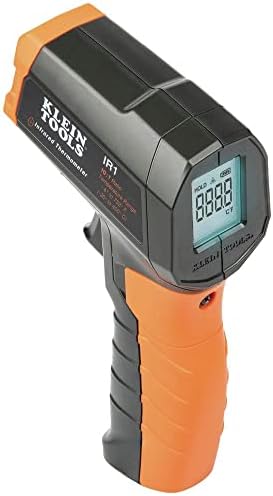
The Klein Tools IR1 targets professionals who need reliable non-contact temperature readings in demanding environments. Its -4°F to 752°F range is specifically calibrated for HVAC diagnostics, electrical panel checks, and mechanical troubleshooting, not general-purpose home use. Buyers should understand that distance-to-spot ratio and emissivity settings are critical for accuracy in industrial applications.
Key Considerations Before Buying
- The 12:1 distance-to-spot ratio means at 12 inches away, the IR1 measures a 1-inch diameter circle; this precision is essential for targeting specific components like circuit breakers or motor bearings.
- With a fixed emissivity of 0.95, this thermometer is optimized for most non-reflective surfaces but may require adjustment techniques (like using electrical tape) for shiny metals, a common consideration in electrical work.
- The single-point laser design, rather than a circle, indicates a tool built for pinpoint measurement accuracy, which professionals prefer over consumer models with less precise targeting.
What Our Analysts Recommend
For professional infrared thermometers, examine the response time (this model updates twice per second) and operating temperature range, as tools like the IR1 must function in both hot mechanical rooms and cold outdoor environments. A robust IP54 rating for dust and water resistance is a key quality indicator for durability on job sites, distinguishing it from lighter-duty home models.
Infrared Thermometers Market Context
Market Overview
The industrial infrared thermometer market is segmented between budget-friendly general-use guns and professional-grade tools with higher accuracy, durability, and specific features like adjustable emissivity. The Klein IR1 occupies a respected middle ground, offering trusted brand reliability and core professional features without the cost of full-featured diagnostic models.
Common Issues
Common user errors in this category include measuring reflective surfaces without proper technique, misunderstanding distance-to-spot ratio leading to inaccurate readings, and confusing non-contact surface temperature with internal or air temperature. Lower-quality models also suffer from slow refresh rates and poor battery life under constant use.
Quality Indicators
Look for clear specifications on accuracy (typically ±2% or better), a wide operating ambient temperature range, and a sturdy, ergonomic design rated for drops. Professional models like the IR1 often feature a dedicated hold button to freeze readings and a backlit display for low-light conditions, which are practical indicators of job-site design.
Review Authenticity Insights
Grade B Interpretation
A Grade B with a 10% estimated fake review rate is strong for this category, indicating a high proportion of genuine feedback from verified purchasers. This suggests the overwhelmingly positive 4.6 adjusted rating is a reliable reflection of real-world user satisfaction, particularly among tradespeople.
Trust Recommendation
Focus on reviews from verified purchasers that mention specific professional use cases like 'checking HVAC duct temps' or 'finding an overheating breaker.' The high volume of reviews (over 3800) allows you to confidently identify consistent patterns of performance and durability over time.
Tips for Reading Reviews
Prioritize detailed reviews that discuss accuracy in side-by-side comparisons with other tools or mention long-term reliability over months of daily use. Be slightly more skeptical of brief, overly enthusiastic 5-star reviews that lack specific application details, as these constitute the estimated 10% less-trustworthy feedback.
Expert Perspective
The Klein Tools IR1 presents a compelling value proposition for trades professionals. Its adjusted 4.6-star rating from thousands of verified purchases strongly indicates it delivers on its core promise: reliable, accurate spot temperature readings in a durable, no-frills package. The high rating authenticity (Grade B) gives confidence that this praise is earned, not manufactured. It's not a lab-grade instrument, but for its intended electrical, HVAC, and mechanical maintenance tasks, the consensus confirms it performs exceptionally well.
Purchase Considerations
Weigh the fixed 0.95 emissivity against your need to measure reflective surfaces; if that's frequent, a model with adjustable emissivity may be better. Consider if the 752°F maximum is sufficient for your applications (e.g., high-temperature exhaust systems). The tool's design prioritizes speed and simplicity, so if you need data logging or Bluetooth connectivity, you must look elsewhere.
Comparing Alternatives
Shoppers should compare the IR1's specs and price against similar models from Fluke and Milwaukee to ensure the feature set aligns with their specific workflow requirements.


