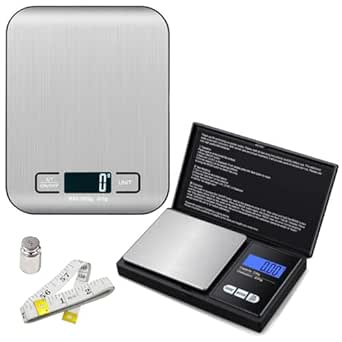
Choosing a Milligram Scale: Precision, Portability, and Calibration Essentials
When selecting a milligram scale like this 50g/0.001g model, buyers must understand that true precision requires more than just advertised specifications. This particular scale's inclusion of calibration weights and tweezers indicates it's designed for applications requiring exact measurements, from jewelry making to laboratory preparations where 1-milligram accuracy matters.
Key Considerations Before Buying
- The 0.001g precision is meaningful only with proper calibration—verify the included 50g weights are certified or at least consistent, as inaccurate calibration renders the precision useless.
- Portability often compromises stability; pocket-sized scales like this one require absolutely level surfaces and protection from air currents to achieve their claimed 1-milligram accuracy.
- The 50g maximum capacity suits small quantities of high-value materials (precious metals, pharmaceuticals, specialty spices) but requires frequent taring for larger measurements, increasing potential error accumulation.
What Our Analysts Recommend
Quality milligram scales feature stable readings that don't drift, automatic calibration features, and protective covers to minimize air current interference. The inclusion of calibration weights suggests this manufacturer understands precision requires verification, but check reviews specifically for consistency after repeated calibration cycles.
Digital Scales Market Context
Market Overview
The Australian market for precision milligram scales has expanded beyond laboratory use to home enthusiasts in coffee, baking, and jewelry making, creating demand for affordable but accurate sub-100g scales. Products in this category compete primarily on claimed precision (0.001g vs 0.01g), maximum capacity trade-offs, and inclusion of calibration tools.
Common Issues
Budget milligram scales frequently suffer from measurement drift, sensitivity to temperature changes, and inconsistent performance at very low weights despite advertising 0.001g precision. Many users don't realize that achieving true milligram accuracy requires meticulous handling and environmental control that challenging in typical kitchen or workshop settings.
Quality Indicators
Look for scales with multiple calibration points (not just 50g), stable platforms that minimize vibration transfer, and clear documentation about measurement uncertainty. The most reliable scales maintain consistency across their entire weight range, not just at maximum capacity where performance is easiest to engineer.
Review Authenticity Insights
Grade B Interpretation
A Grade B authenticity rating with 15% estimated fake reviews indicates generally trustworthy feedback but suggests some review manipulation exists. For this scale, the gap between the raw 4.44 rating and adjusted 4.10 rating suggests inflated positive reviews may exaggerate precision claims or durability.
Trust Recommendation
Focus on verified purchase reviews that discuss specific use cases like measuring jewelry components or coffee beans, as these demonstrate real-world testing. Be particularly skeptical of reviews claiming 'perfect accuracy' without describing calibration procedures or environmental controls.
Tips for Reading Reviews
Prioritize reviews that mention using the included calibration weights, testing with known weights, or comparing measurements against professional equipment. Look for patterns in critical reviews—if multiple users report similar drift issues at low weights, this indicates a genuine product limitation rather than user error.
Expert Perspective
This scale's specifications suggest it targets serious hobbyists needing milligram precision, though its 4.10 adjusted rating indicates some performance variability. The inclusion of calibration weights and tweezers shows thoughtful design for precision applications, but the pocket-sized format inherently challenges measurement stability. The 1371 verified reviews provide substantial data, with the authenticity analysis suggesting generally reliable feedback despite some inflation.
Purchase Considerations
Consider whether you truly need 0.001g precision or if 0.01g would suffice, as the former demands meticulous usage conditions. Evaluate if the 50g capacity meets your needs without constant taring, and whether the portable format's convenience outweighs potential stability compromises compared to larger benchtop models.
Comparing Alternatives
Compare this scale's performance consistency in reviews against similar-priced models offering 0.001g precision, particularly noting calibration methodologies and low-weight accuracy claims.

![Digital Kitchen Scale, [5kg/0.1g] Diyife Rechargeable Food Scale,High Precision Pocket Food Scale with LCD Display, Tare Function Stainless Steel Platform, Digital Scale for Food, Medicin,Jewelry](https://m.media-amazon.com/images/I/41ZfAOYUnTL._SX342_SY445_QL70_ML2_.jpg)