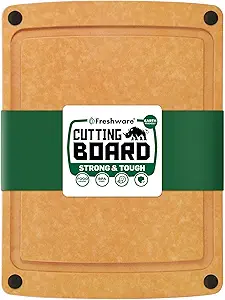
Choosing a Hybrid Cutting Board: Wood-Fiber Composite with Silicone Features
The Toptier board represents a modern hybrid category combining wood-fiber composite construction with practical silicone elements. Buyers should understand this isn't traditional wood nor plastic, but a composite material engineered for dishwasher safety while maintaining some wood-like characteristics. The 11.5 x 9.25-inch dimensions make this specifically a small prep board rather than a primary cutting surface.
Key Considerations Before Buying
- The 'wood fiber' composite construction differs from solid wood or bamboo—it's engineered for dimensional stability and dishwasher safety but may not have the same self-healing properties as end-grain hardwood.
- Silicone feet and juice grooves add functionality but create cleaning considerations where food particles can accumulate at material junctions.
- The 'natural slate' color and non-porous claim suggest this board uses resin binding in the composite, which affects knife feel compared to traditional wood surfaces.
What Our Analysts Recommend
Quality indicators include consistent edge finishing where silicone meets composite, smooth transitions at juice groove edges, and uniform coloration suggesting proper resin distribution. Check that silicone feet provide genuine non-slip performance on your countertop material, as some surfaces reduce effectiveness.
Cutting Boards Market Context
Market Overview
The cutting board market has expanded beyond traditional materials to include engineered composites like this wood-fiber blend, which attempt to balance aesthetics, functionality, and maintenance. Small boards with premium features represent a growing niche for limited-space kitchens or secondary prep stations.
Common Issues
Composite boards sometimes develop surface cloudiness after repeated dishwasher cycles, and silicone elements can detach if adhesive fails. Juice grooves on smaller boards may overflow quickly with juicy ingredients, limiting their practical utility.
Quality Indicators
Look for boards specifying fiber source (often bamboo or recycled wood), resin type (BPA-free is standard), and dishwasher cycle limits. Quality composites maintain flatness without warping and have silicone securely bonded without gaps where bacteria could accumulate.
Review Authenticity Insights
Grade B Interpretation
A Grade B with 15% estimated fake reviews indicates generally reliable feedback but suggests some review manipulation exists. The drop from 4.89 to 4.50 adjusted rating shows inflated initial scores, though verified purchases increase credibility.
Trust Recommendation
Focus on reviews discussing specific performance aspects like dishwasher durability over multiple cycles, actual non-slip performance on various surfaces, and how the composite material holds up to different knife types. Verified reviews mentioning long-term use (3+ months) carry more weight.
Tips for Reading Reviews
Look for reviews that mention the board's actual thickness (not just dimensions), how the composite surface affects knife sharpness, and whether juice grooves are proportionally useful on this smaller size. Reviews discussing material comparisons (vs. plastic, wood, or bamboo) provide valuable context.
Expert Perspective
This board occupies a specific niche: those wanting wood aesthetics with plastic-like maintenance convenience. The high adjusted rating (4.50/5) from verified purchasers suggests genuine satisfaction, particularly regarding dishwasher safety and non-slip features. However, the composite material represents a compromise—it won't perform identically to premium hardwood or offer the same longevity as professional-grade polyethylene. The small size makes it suitable for fruit, cheese, or herb preparation rather than primary protein processing.
Purchase Considerations
Consider whether dishwasher convenience outweighs potential trade-offs in knife feel and long-term surface appearance. The eco-friendly claim should be evaluated against actual material sourcing information—some composites use formaldehyde-free resins but may not be biodegradable. For households needing multiple specialized boards, this could serve well as a secondary board for specific tasks.
Comparing Alternatives
Shoppers should compare this hybrid approach against separate purchases: a traditional wood board for knife care plus a dishwasher-safe plastic board for raw proteins.