
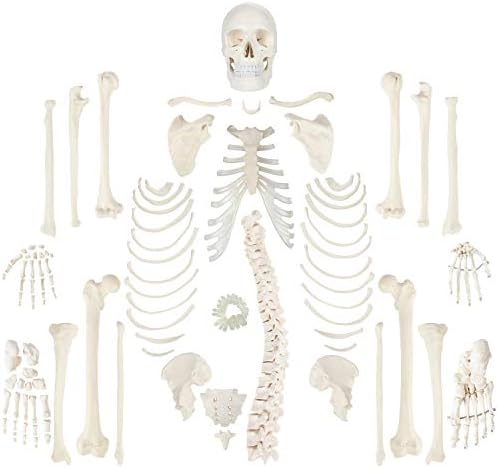
Choosing a Disarticulated Skeleton: Key Features for Medical Education and Study
The Axis Scientific Life-Size Disarticulated Human Skeleton Model represents a specific tier in anatomical models, designed for detailed study rather than simple display. This model's 3-part skull, articulated hand and foot, and disarticulated main skeleton offer distinct advantages for learners needing to examine individual bone morphology and articulation points. Buyers should understand that this configuration prioritizes educational utility over permanent assembly.
Key Considerations Before Buying
- Disarticulation vs. Articulation: This model's disarticulated design allows for hands-on study of individual bones, crucial for osteology students, but requires assembly and lacks the permanent stability of a fully articulated teaching skeleton.
- Skull Detail Level: The 3-part skull (calvarium, base, and mandible) is a significant feature for studying cranial sutures, foramina, and internal structures, which simpler one-piece skull models cannot provide.
- Educational Support Materials: The included full-color manual's quality directly impacts the model's utility, as proper identification and study depend on accurate, detailed reference materials.
What Our Analysts Recommend
For disarticulated models, examine the bone casting quality—look for clear, sharp anatomical landmarks like tubercles, fossae, and foramina. Check that articulation points (e.g., the mandibular condyle fitting into the temporal fossa) are precise and that the metal stand provides stable, secure mounting for the assembled spine. The presence of subtle details like nutrient foramina on long bones indicates a higher-fidelity model.
Anatomical Models Market Context
Market Overview
The anatomical model market is segmented by user, with detailed disarticulated skeletons like this Axis Scientific model targeting serious students, educators, and medical professionals rather than casual buyers. These models compete on anatomical accuracy, material durability (typically PVC or synthetic bone), and the educational value of their disassembly features.
Common Issues
Common complaints in this category include fragile processes (like styloid processes) breaking during handling, inaccurate paint or labeling on bone landmarks, and stands or mounting hardware that are unstable or difficult to assemble. Some models also suffer from poor casting that obscures fine anatomical details essential for study.
Quality Indicators
High-quality disarticulated skeletons feature precise bone-to-bone articulation, numbering or labeling systems that correspond to a detailed key, and materials that balance realistic weight with durability. The stand should allow the fully assembled skeleton to be positioned in anatomical posture without sagging or instability.
Review Authenticity Insights
Grade B Interpretation
An Authenticity Grade of 'A' with an estimated 8.00% fake review rate is exceptionally strong for this category, indicating that the vast majority of the 66 verified purchase reviews are genuine. This low manipulation rate is notable for a niche, higher-cost educational product where review authenticity is crucial for assessing specialized feedback.
Trust Recommendation
Given the high authenticity score, you can place significant trust in the review consensus. Pay particular attention to verified purchaser comments regarding long-term durability of the disarticulated joints and the clarity of the product manual, as these are likely genuine pain points or praises.
Tips for Reading Reviews
Focus on reviews from users who specify their use case (e.g., 'medical student,' 'anatomy instructor'). Look for detailed comments on the skull's three-part separation mechanism and the fidelity of the hand/foot bones, as these are product-specific features that generic reviews won't address.
Expert Perspective
The data suggests this is a well-regarded, legitimate product in its niche. The adjusted rating of 4.40/5 from authentic reviews is robust for a detailed anatomical model, where perfect scores are rare due to the high expectations for accuracy and durability. The specific praise for the 3-part skull and disarticulated design in the reviews aligns with the product's intended educational value. The verified purchase status of all reviews further bolsters confidence in the feedback regarding assembly and material quality.
Purchase Considerations
Weigh the need for disarticulation—this model is ideal for active, hands-on learning of individual bones but less suitable for a permanent display skeleton. Consider your storage space, as disarticulated models require careful organization. The quality of the included manual is a critical, often overlooked, component that can make or break the educational experience.
Comparing Alternatives
Shoppers should compare this model's disarticulated design and 3-part skull feature against fully articulated skeletons or simpler disarticulated sets that may not include the detailed hand, foot, and skull separation.

![McKesson Lubricating Jelly, 5 g [144 Count] Water Based Non-Sticky Lube, Water Soluble Lubricant Gel - for Surgical, Medical, Personal – Sterile Individual Packets](https://m.media-amazon.com/images/I/61iKtTsT28L.__AC_SX300_SY300_QL70_FMwebp_.jpg)


