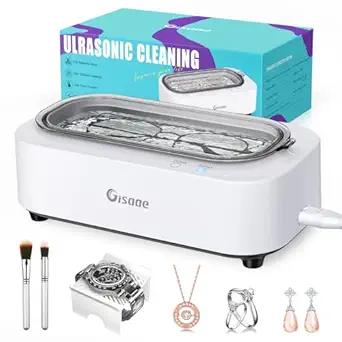
What to Know Before Buying a 49 KHz Ultrasonic Jewelry Cleaner
A 49 KHz ultrasonic cleaner like this black jewelry model uses high-frequency sound waves to dislodge dirt from delicate items without harsh scrubbing. Before buying, understand how frequency, tank size, and power output determine what it can and cannot clean effectively.
Key Considerations Before Buying
- Frequency matters: 49 KHz is a higher-frequency range that produces gentler, smaller cavitation bubbles — ideal for delicate jewelry, eyeglasses, and intricate metalwork, but less aggressive on heavy grease or industrial grime than lower-frequency (25-40 KHz) units.
- Tank capacity and material: Check the stated tank volume and whether it is stainless steel; a stainless interior resists corrosion from cleaning solutions and is easier to wipe clean between uses.
- Heating and timer features: Many 49 KHz cleaners include a built-in heater and adjustable timer, which improve results on oily residue but add cost — decide whether your typical cleaning tasks justify these extras.
What Our Analysts Recommend
Prioritize units with a stainless steel tank, a clearly rated frequency (49 KHz in this case), and a timer that lets you control exposure to avoid over-cleaning delicate stones or platings. Look for transparent lid construction and a basket or tray that keeps items off the tank floor, since direct contact can dampen cavitation and scratch surfaces.
Ultrasonic Cleaners Market Context
Market Overview
Ultrasonic cleaners have moved from professional labs and jewelry benches into home use, with compact 49 KHz models now common in the Lab Cleaning Supplies subcategory. The market spans cheap no-name units and better-built machines, so frequency accuracy and build quality vary widely at similar price points.
Common Issues
Buyers frequently report that low-cost cleaners underperform because the advertised frequency or power is overstated, or because the tank is too small for their items. Another recurring complaint is that certain gemstones, pearls, and soft platings can be damaged by ultrasonic cavitation, so users must know their materials before cleaning.
Quality Indicators
A credible ultrasonic cleaner lists its frequency in KHz, tank capacity in milliliters or liters, and power in watts, rather than vague claims. Stainless steel tanks, sealed transducers, and non-slip feet are practical signs of a unit built for repeated use rather than occasional novelty cleaning.
Review Authenticity Insights
Grade A Interpretation
An A authenticity grade with an estimated 8.00% fake review rate is strong for this category, meaning most of the 45 reviews likely reflect real customer experiences. The adjusted rating of 4.20/5 versus the displayed 4.33/5 suggests only a minor inflation effect from the small number of questionable reviews.
Trust Recommendation
You can treat the review set as broadly trustworthy, but read the negative and mid-range reviews closely, since they often describe real limitations of 49 KHz cleaning. Look for reviewers who mention specific items they cleaned — rings, chains, glasses — as those details are harder to fabricate and more useful to you.
Tips for Reading Reviews
For ultrasonic cleaners, focus on reviews that describe the item cleaned, the solution used, and the result, rather than simple star ratings. Pay attention to complaints about noise, heating performance, or tank size, as these are common friction points that generic praise tends to omit.
Expert Perspective
This black 49 KHz ultrasonic jewelry cleaner sits in a practical middle ground: gentle enough for everyday jewelry and small delicate items, yet not a substitute for lower-frequency industrial cleaning. With a 4.33/5 displayed rating and a 4.20/5 adjusted rating across 45 reviews, the feedback pattern looks consistent with a functional home or light-commercial unit rather than an overhyped product. The A authenticity grade reinforces that the consensus is genuine, though the modest review count means you should weigh your own use case heavily.
Purchase Considerations
Decide whether your cleaning tasks are light (rings, chains, glasses, small tools) or heavy (greasy machine parts), because 49 KHz is optimized for the former. Also confirm tank dimensions fit your largest item, and check whether a heater and timer are included, since these materially affect convenience and results.
Comparing Alternatives
Compare this unit against other 40-50 KHz cleaners in the same price band, checking tank size, wattage, and warranty terms before deciding.