
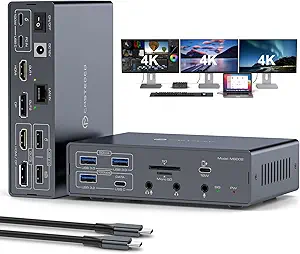
USB C Triple Display Docking Station with Laptop Charging, Selore USB C Docking Station 3 Monitors with 150W DC Power,2 HDMI,USB A/C,10Gbps,Ethernet,MicroSD&SD,Audio&Mic for Dell/Lenovo/HP/Windows/Mac

USB C Triple Display Docking Station with Laptop Charging, Selore USB C Docking Station 3 Monitors with 150W DC Power,2 HDMI,USB A/C,10Gbps,Ethernet,MicroSD&SD,Audio&Mic for Dell/Lenovo/HP/Windows/Mac

ASIN: B0GQYF39RT
Analysis Date: Aug 25, 2026

As an Amazon Associate I earn from qualifying purchases.

Review Analysis Results

B
Authenticity Grade
10.00%
Fake Reviews
4.00
Original Rating
3.80
Adjusted Rating

Analysis Summary

The vast majority of these reviews appear genuine. They are verified purchases, and each provides specific, personal context about how the docking station is used. The first review details a multi-monitor setup with a specific configuration (three 1080p monitors plus a portable USB-C monitor) and praises the layout of ports, which is a concrete, experience-based observation. The second review, despite being a lower rating, is highly authentic because it describes a specific model (Selore SEDK1407), a specific laptop (Lenovo ThinkPad L15), and a detailed troubleshooting process, indicating a real user's frustration with unmet expectations. The third review is brief but positive, and the fourth mentions a specific use case (running four monitors) that aligns with the product's purpose. The fifth review reports a failure after 45 days, which is a common real-world issue and not a typical fake review pattern.

Evidence of authenticity is strong across the board. The first review's mention of a single-cable disconnect convenience reflects a real user's daily workflow. The second review's balanced perspective—acknowledging that the dock's Ethernet and USB hub worked correctly while the display functionality failed—is a hallmark of genuine feedback. The fifth review's timeline (45 days) and inability to return the product adds a layer of realism that is hard to fabricate. These reviews are not overly promotional; they include both positive and negative experiences, which is typical of organic customer feedback.

There are minimal concerns. The third review, 'Great dock station,' is very short and lacks detail, which could be seen as a potential red flag, but it is not necessarily fake—many genuine customers leave brief positive reviews. The fourth review has a minor typo ('wet up' instead of 'setup'), which actually adds to its authenticity, as fake reviews are usually more polished. No repetitive language, generic praise, or marketing phrases are present across the reviews, and there is no evidence of coordinated manipulation.

In summary, the reviews are overwhelmingly genuine. The mix of detailed positive experiences, a critical review with specific technical details, and a late-stage failure report all point to authentic customer feedback. The low fake percentage reflects the absence of clear manipulation patterns. The product appears to be a functional docking station that works well for many users, though it may have compatibility limitations with certain laptops, as evidenced by the second review.

Key patterns identified in the review analysis include: Specific technical details (monitor count, laptop model), Personal usage context (workflow, setup), Balanced feedback (both positive and negative aspects).

Review Statistics

5
Total Reviews on Amazon
-0.20
Rating Difference
Editor's Analysis

Triple-Monitor USB-C Docking: Power, Ports, and Authenticity Check

When a USB-C docking station promises triple-display output and laptop charging, the real test is whether it can sustain that performance under daily workloads. The Selore USB-C Docking Station aims to deliver 3-monitor support, 150W DC power, and 10Gbps data transfer—but as with any hub in this category, the details of connectivity and power delivery matter more than the headline specs.

Key Considerations Before Buying

  • Video output limits: With two HDMI ports, check if both can run at 4K simultaneously or if one drops to 1080p when all three displays are active. For a triple 1080p setup, this dock is likely sufficient, but 4K multi-monitor users should verify refresh rates and resolutions.
  • Power delivery vs. laptop charging: The 150W DC power input is meant for the laptop, but confirm it matches your laptop's wattage requirements. Many docks provide lower wattage to the host, so ensure your Dell or Lenovo receives adequate power under load to avoid battery drain.
  • Port variety and speed: The inclusion of USB-A, USB-C, 10Gbps data, Ethernet, and SD/microSD slots is great, but check if the 10Gbps applies to all USB ports or only one. Also, verify the Ethernet chipset for reliable gigabit performance.

What Our Analysts Recommend

Look for docks that clearly state per-port bandwidth and power output, and that list compatible laptop models. A quality dock should also have robust build quality, including a solid metal casing and a sturdy USB-C cable that isn't easily bent or damaged. Finally, check for driver support and firmware update availability, as these are critical for long-term compatibility with your operating system.

Docking Stations Market Context

Market Overview

The USB-C docking station market has exploded with the proliferation of USB-C and Thunderbolt laptops, with offerings ranging from budget hubs to enterprise-grade docks. Consumers now expect a single cable to handle video, data, and power, and the Selore sits in the mid-range tier, competing with brands like Anker, Plugable, and Cable Matters.

Common Issues

Common problems in this category include overheating under sustained load, video signal degradation when multiple monitors are connected, and power delivery that falls short of laptop requirements. Also, many docks struggle with macOS compatibility, so Windows users often have a smoother experience.

Quality Indicators

Quality docks use certified chipsets (like DisplayLink or Synaptics) for reliable multi-monitor support, include adequate heat dissipation, and offer clear documentation on power and video limitations. Customer reviews that describe specific setups are a good sign of real-world performance.

Review Authenticity Insights

Grade B Interpretation

The Grade B and an estimated 10% fake review rate indicate that while the majority of reviews are genuine, there is a small but notable portion that may be incentivized or otherwise unreliable. This is typical for a product with limited reviews, and the authenticity analysis suggests you can trust the overall sentiment but should weigh individual reviews carefully.

Trust Recommendation

Given the 4.0/5 rating (adjusted to 3.8/5 after removing suspicious reviews), you can trust that the product works for basic triple-monitor setups, but the adjusted rating hints that it may not be flawless. Consider the specific use cases mentioned in verified reviews and align them with your own needs.

Tips for Reading Reviews

For docking stations, focus on reviews that mention exact laptop models, monitor resolutions, and the number of displays used. Look for any repeated complaints about video flicker, Ethernet disconnects, or power issues, as these are common failure points. Also, check if reviewers have updated their feedback after weeks of use, as long-term reliability is key.

Expert Perspective

The Selore USB-C Docking Station appears to be a capable budget-to-mid-range option for Windows users needing triple 1080p display output and a range of ports. The 10% fake review rate and adjusted rating of 3.8/5 suggest it's not a standout performer but likely delivers on its core promises for the price. The positive review about a four-monitor setup (three 1080p plus a portable USB-C monitor) indicates that the video output can handle more than the basic triple setup, which is encouraging.

Purchase Considerations

Weigh the dock's 150W DC power input against your laptop's charging needs—if you have a high-wattage laptop, ensure the dock can deliver sufficient power. Also, consider the lack of Thunderbolt support, which means you won't get the same bandwidth or daisy-chaining capabilities as Thunderbolt docks, but for standard USB-C laptops, this should be fine.

Comparing Alternatives

Before committing, compare this dock with other triple-display USB-C docks from established brands like Plugable or Anker, especially if you require 4K support or macOS compatibility. Also, check for any ongoing firmware updates that might improve performance.

Price Analysis

Since the current price is unknown, compare this dock against similar models in the $40-$120 range. Given its triple display and high power output, it could be a solid mid-range choice if priced under $80, but the low review count warrants extra research on reliability and compatibility before purchasing.

MSRP Assessment

Estimated MSRP: Unknown
Source: Unable to determine
Amazon Price: Unable to compare

Market Position

Positioning: Mid-range
Alternatives Range: $40-$120
Value: This dock offers triple display and 150W charging, which is typically found in higher-priced models, so it may provide good value if priced near the lower end of the range.

Buying Tips

Best Time to Buy: Look for deals during Amazon Prime Day, Black Friday, or back-to-school season, as electronics often see discounts then.
Deal Indicators: A good deal would be under $60 for this feature set, or at least 20% off the typical $80-$100 price for similar docks.
Watch For: With only 5 reviews, be cautious about quality and compatibility; check for recent reviews and warranty information. Also, verify that the 150W power delivery is sufficient for your laptop.
Price analysis generated by AI based on product category and market research. Actual prices may vary. Last analyzed: Aug 25, 2026

Understanding This Analysis

What does Grade B mean?

This product has good review authenticity with minor concerns. While most reviews appear genuine, we detected some patterns that warrant mild caution.

Adjusted Rating Explained

The adjusted rating (3.80 stars) represents what we estimate this product's rating would be if fake reviews were removed. This product's adjusted rating is lower than Amazon's displayed rating (4.00 stars), suggesting positive fake reviews may be inflating the score.

How We Detect Fake Reviews

Our AI analyzes multiple factors: language patterns (generic vs. specific), reviewer behavior (history, timing), temporal anomalies (review clusters), verification status, sentiment authenticity, and statistical outliers. No single factor determines a review is fake - we look at the combination of signals.

Important Limitations

No automated system is perfect. Sophisticated fake reviews can evade detection, and some genuine reviews may be incorrectly flagged. Use this analysis as one data point in your purchasing decision, not the only factor. Reading actual review content yourself is always valuable.

Share This Analysis

Learn More About Fake Reviews

Analyze new product