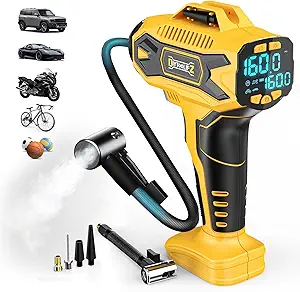
What to Know Before Buying a Cordless 150 PSI Tire Inflator
A cordless 150 PSI inflator like this one promises garage-free tire maintenance, but real-world performance hinges on battery runtime, inflation speed, and how accurately the auto shut-off hits your target pressure. Since this model targets cars, motorcycles, bikes, and balls, buyers should weigh its versatility against the higher demands of topping off a full-size SUV tire.
Key Considerations Before Buying
- Battery capacity versus PSI rating: a 150 PSI max matters less than how many tires one charge can fill, so check whether reviewers report completing all four car tires or just one before recharging.
- Auto shut-off accuracy: this feature prevents overinflation, but its value depends on the gauge reading within 1–2 PSI of your setpoint, so look for reviewer mentions of pressure consistency.
- Nozzle and adapter compatibility: the included presta valve, ball needle, and standard chuck determine whether it truly handles motorcycles, bikes, and sports equipment without extra purchases.
What Our Analysts Recommend
Prioritize models with a built-in digital gauge rather than an analog dial, since digital readouts reduce guesswork at the pump. Also check whether the LED light is bright enough for nighttime roadside use and whether the hose stays flexible in cold weather, as stiff hoses make valve attachment frustrating.
Air Compressors & Inflators Market Context
Market Overview
The portable inflator market has shifted decisively toward cordless, lithium-powered units as drivers move away from 12V cigarette-lighter cords that tether them to the car. At the same time, budget inflators flood the category, so a 150 PSI cordless pump with smart shut-off now sits in a crowded field where brand trust and battery quality separate the reliable from the disposable.
Common Issues
The most frequent complaints in this category involve slow inflation times on larger tires, batteries that lose charge between uses, and auto shut-off mechanisms that either overshoot or stop short of the set pressure. Cheap units also tend to overheat during extended use, forcing cooldown pauses that defeat the purpose of a quick top-off.
Quality Indicators
A quality inflator typically shows a metal or reinforced pump cylinder, a clearly readable digital gauge, and a battery that holds charge for weeks in a trunk. Look for units that specify inflation time per tire size (for example, minutes to inflate a 225/65R17 from 30 to 35 PSI) rather than vague claims like 'fast inflation.'
Review Authenticity Insights
Grade A Interpretation
An A authenticity grade with an estimated 8% fake review rate means the overwhelming majority of this product's 69 reviews reflect real customer experiences, which is unusually clean for an Amazon automotive accessory. The adjusted 4.80/5 rating, down only slightly from 5.00, suggests that even after discounting suspicious reviews, buyers remain highly satisfied.
Trust Recommendation
Shoppers can treat this product's review profile as reliable, but should still verify that positive reviews mention specific use cases like tire size or inflation time rather than generic praise. With only 69 reviews, the sample size is modest, so it's worth checking whether the rating holds steady as more buyers report in.
Tips for Reading Reviews
For inflators, focus on reviews that cite PSI accuracy, battery life per charge, and performance on the reviewer's actual vehicle type. Ignore reviews that only praise the LED light or packaging, and pay attention to any reviewer who reports the auto shut-off failing, since that is a safety-relevant function.
Expert Perspective
This cordless 150 PSI inflator presents a strong case for drivers who want a trunk-ready pump for occasional top-offs and seasonal pressure changes. The A authenticity grade and 4.80 adjusted rating indicate genuine buyer satisfaction, and the multi-nozzle design extends its usefulness to motorcycles, bikes, and sports gear. However, with just 69 reviews, it lacks the long-term reliability data that more established competitors have accumulated.
Purchase Considerations
Weigh how often you actually need to inflate tires versus how often you'd use it for bikes and balls, since a car-focused buyer may prioritize inflation speed and battery capacity while a cyclist may care more about a precise low-pressure gauge. Also consider whether the LED light and auto shut-off justify the price against a simpler corded model.
Comparing Alternatives
Before buying, compare this unit with other cordless inflators that specify inflation times for common tire sizes and offer longer warranties, as those details often reveal which product will hold up over years of trunk storage.