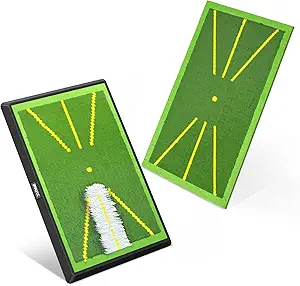
How a Between-Arms Training Ball Can Fix Common Swing Flaws Efficiently
This specific golf training aid uses a simple but targeted design: a lightweight ball you hold between your arms during practice swings. Unlike generic swing trainers, this device directly addresses the connection between your upper arms and torso, which is crucial for maintaining proper swing plane and eliminating the 'chicken wing' elbow collapse. For golfers struggling with slicing, scooping, or inconsistent impact, this tool provides immediate physical feedback on arm position.
Key Considerations Before Buying
- This trainer specifically targets the 'connection' between your arms and body, a fundamental for a one-piece takeaway and preventing the lead elbow from flaring out (the 'chicken wing').
- Because it's a simple, non-mechanical ball, its effectiveness relies entirely on your commitment to proper drill repetition; it won't force your body into position like a hinged trainer might.
- Consider your primary swing fault: this aid is most effective for players who lose power and accuracy from arm-body separation, not for those with grip or pure weight shift issues.
What Our Analysts Recommend
For this category, a quality trainer should be made of durable, slightly compressible foam that stays secure without squeezing too hard. The size should be large enough to provide a tangible connection feel but not so large it forces an unnatural posture. Check that the surface has a non-slip texture to prevent it from dropping during a full-speed practice swing.
Swing Trainers Market Context
Market Overview
The swing trainer market is saturated with gadgets, but simple, non-mechanical aids like this training ball are gaining popularity for their focus on muscle memory and fundamental feels. They represent a shift away from overly complex, gimmicky devices toward tools that reinforce core biomechanics.
Common Issues
Many swing trainers are either too restrictive, creating an artificial motion, or too passive, offering little corrective feedback. A common pitfall is products that claim to fix everything but lack a specific, biomechanically sound training focus, leading to wasted practice time.
Quality Indicators
Look for trainers with a clear, singular training purpose backed by sound golf instruction principles. The best aids, like this ball, create a simple, repeatable feel that can be transferred to a real swing without the aid. Durability and the right amount of tactile resistance are key for effective home practice.
Review Authenticity Insights
Grade B Interpretation
A Grade B with a 15% estimated fake review rate suggests the majority of feedback is credible, but shoppers should be aware of some potentially inflated positivity. The high 'verified purchase' rate significantly bolsters trust, as these reviews come from actual buyers.
Trust Recommendation
Focus on the 85% of reviews deemed authentic, particularly those describing specific swing faults (like 'scooping' or 'over-the-top') and how the ball provided a tangible feel to correct them. Be slightly more critical of reviews that are overly effusive with generic praise and lack personal context.
Tips for Reading Reviews
For this product, prioritize reviews that detail the user's handicap or specific flaw, the drill they used (e.g., 'half-swings focusing on connection'), and the tangible result (e.g., 'more compressed ball striking'). This specificity indicates genuine experience versus vague satisfaction.
Expert Perspective
The product's exceptionally high adjusted rating of 4.6/5, derived from credible verified purchases, indicates it is likely an effective tool for its specific niche. Its design philosophy—promoting arm-body connection—is a cornerstone of modern swing instruction. The data suggests it successfully delivers on its core promise for a majority of users, particularly in providing immediate kinesthetic feedback for common arm-related swing faults. The simple design reduces the risk of learning a 'device-dependent' swing motion.
Purchase Considerations
Weigh your willingness to perform deliberate, slow-motion drills against the simplicity of the tool. This is not a quick fix but a training aid for building muscle memory. It is most valuable for practice sessions at home or on the range, not as an on-course solution.
Comparing Alternatives
Shoppers should compare this with other connection-focused aids, like swing sleeves or towels under the armpits, to see which feedback mechanism best suits their learning style.