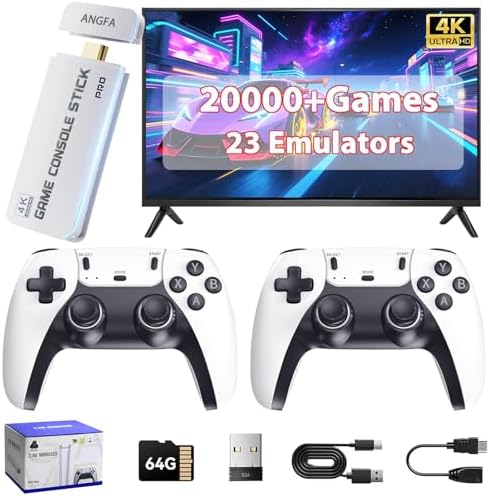
Navigating the 20,000+ Game Retro Console: What Plug-and-Play Really Means
This specific '2026 New Upgrade' retro console markets itself as an all-in-one solution with 4K output and 23 emulators, but buyers should understand that such expansive game libraries often contain duplicates and region variants. The dual 2.4G wireless controllers and 64GB storage suggest a focus on convenience, but the actual emulation quality and game curation are the true tests of value.
Key Considerations Before Buying
- The '23 emulators' claim requires scrutiny—effective emulation of systems like PlayStation 1, N64, or Sega Saturn is far more demanding than 8-bit systems, and performance varies wildly between console models in this category.
- 4K output for retro games is largely a marketing point; most original game assets were designed for 240p-480i resolutions, so the upscaling processor's ability to handle interpolation without introducing lag or visual artifacts is critical.
- A library of '20,000+ games' often includes hundreds of poorly translated ROM hacks, multiple versions of the same title across regions, and filler software—the actual count of desirable, playable classics is typically a small fraction.
What Our Analysts Recommend
Prioritize consoles that specify the systems emulated (e.g., 'supports NES, SNES, Genesis, PS1') rather than just an emulator count. Check if the manufacturer provides firmware updates, as this indicates ongoing support for bug fixes and compatibility improvements. The quality of the 2.4G controllers—their latency, build, and button feel—often determines the long-term enjoyment more than the game count.
Consoles Market Context
Market Overview
The retro gaming console market is flooded with Android-based plug-and-play devices, many making similar claims about game counts and 4K support. Differentiation typically comes from build quality, controller responsiveness, and the user interface's ease of navigation through massive libraries.
Common Issues
Common problems include input lag on wireless controllers that ruins timing-based games, poorly organized game menus, inaccurate emulation causing graphical glitches or sound issues, and the use of low-quality NAND flash storage that can fail. Many consoles also lack proper licensing for the pre-loaded games.
Quality Indicators
Look for mentions of specific emulators used (like RetroArch cores), transparency about the system-on-chip (SoC) hardware (e.g., Allwinner H616, Rockchip RK3326), and community forums where users discuss custom firmware. A well-designed front-end menu with search, favorites, and save-state management is a sign of thoughtful engineering.
Review Authenticity Insights
Grade U Interpretation
A Grade 'U' with a 0.00% fake review rate and zero total reviews means there is absolutely no verified purchase feedback for this specific 2026-upgraded model. This places all evaluation burden on the product specifications and manufacturer claims alone.
Trust Recommendation
Treat all performance claims—especially regarding 4K output and compatibility across 23 emulators—as unproven until independent testing emerges. Given the lack of reviews, consider this a first-adopter purchase with higher risk, and verify the seller's return policy thoroughly.
Tips for Reading Reviews
For unreviewed products like this, search for reviews of previous models from the same brand (e.g., '2025 version') to identify pattern issues. Pay close attention to reviews that mention specific games or systems you care about, as performance is not uniform across all emulated platforms.
Expert Perspective
This product represents the current peak of claims in the retro console space: maximum game count, maximum emulator support, and 4K resolution. However, these specs are often at odds; a device powerful enough to emulate 23 different systems well, particularly 3D consoles, requires more robust hardware than typically found in sub-$100 plug-and-play sticks. The 64GB storage is adequate but will be filled primarily by the pre-loaded ROMs, leaving little room for adding your own games. The complete absence of user reviews (Grade U) makes it impossible to verify if the '2026 New Upgrade' represents meaningful improvement over previous generations.
Purchase Considerations
Weigh your tolerance for tinkering against desire for convenience. If you want a curated, 'it just works' experience for a specific era (like 16-bit), a console with a smaller, verified library may be more satisfying. If you're technically inclined and value breadth over perfection, this could be a cost-effective experiment, but set realistic expectations for performance on later-generation systems.
Comparing Alternatives
Shoppers should compare the hardware specs (SoC, RAM) and UI features of similar multi-emulator sticks from brands like Anbernic, Retroid, or even Raspberry Pi-based solutions.