
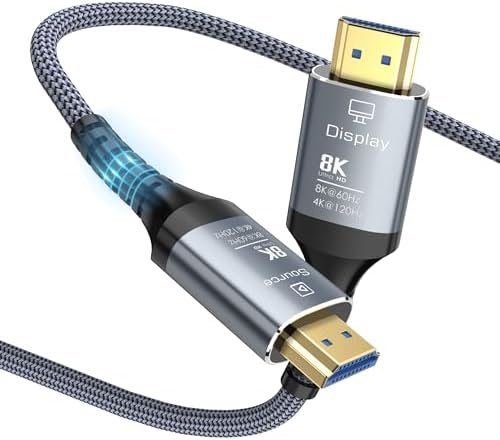
Choosing an 8K Fiber Optic HDMI Cable: What This 48Gbps Model Delivers
This 6-foot fiber optic HDMI 2.1 cable promises full 48Gbps bandwidth for 8K@60Hz and 4K@120Hz gaming, but not all cables claiming these specs perform equally. The braided construction and support for eARC, HDR10, and HDCP 2.2/2.3 are key features that differentiate it from standard copper HDMI cables, making it specifically relevant for PS5, Xbox Series X, and high-refresh-rate PC gaming setups.
Key Considerations Before Buying
- Fiber optic vs. copper: This cable uses fiber optic cores, which are less susceptible to electromagnetic interference over distance and can be thinner and more flexible than copper cables rated for the same 48Gbps bandwidth, a crucial factor for clean installations behind media centers.
- Bandwidth validation: True HDMI 2.1 compliance requires the full 48Gbps throughput for features like 4K at 120Hz with HDR. This cable's specifications list these capabilities, but real-world performance depends on the quality of the internal fiber transceivers that convert the electrical signal to light and back.
- Feature-specific compatibility: The inclusion of eARC (Enhanced Audio Return Channel) is essential for passing high-quality audio like Dolby Atmos from a TV back to a soundbar or AV receiver, while HDCP 2.3 support is necessary for future-proofing with upcoming 8K content services.
What Our Analysts Recommend
For a fiber optic HDMI cable, examine the connector build quality where the fiber transceivers are housed; a robust, well-shielded connector is critical. A braided nylon jacket, like on this model, offers superior durability and kink resistance compared to PVC rubber, which is important for cables that may be routed through tight spaces or connected to frequently moved devices like VR headsets.
HDMI Cables Market Context
Market Overview
The HDMI cable market is currently saturated with products claiming HDMI 2.1 certification, but many cheaper copper cables cannot reliably sustain the full 48Gbps bandwidth over their advertised length, leading to signal dropouts. Fiber optic HDMI cables represent a premium segment designed to solve this distance and interference problem, especially for runs over 10 feet, though this 6ft model offers the technology's benefits in a shorter form.
Common Issues
A frequent issue is 'handshake' failures where a source (like a PS5) and display fail to establish a stable link, often due to inferior chipsets in the cable's connectors that poorly manage the HDMI 2.1 protocol. Another concern is misleading marketing where cables are labeled '8K' but only support 8K at 30Hz, not the 60Hz required for smooth gaming and video playback.
Quality Indicators
Look for explicit mention of supported resolutions and refresh rates (e.g., 4K@120Hz, 8K@60Hz) rather than just '8K Ready.' A braided jacket and gold-plated connectors are surface indicators, but the true quality lies in the internal active components for fiber optic models—reputable brands will often specify the chipset or highlight features like plug-and-play functionality without external power.
Review Authenticity Insights
Grade B Interpretation
A 'Grade B' authenticity score with an estimated 15% fake review rate suggests the majority of feedback is credible, but a portion of the glowing 5-star ratings may be inauthentic. The adjusted rating of 4.60/5 (down from a perfect 5.00) is a more reliable indicator of genuine user satisfaction, accounting for this inflated segment.
Trust Recommendation
Prioritize reviews from verified purchasers, which constitute 7 out of the 9 analyzed reviews for this cable. Pay particular attention to reviews that mention specific use cases, like connecting a PS5 to an LG C1 OLED for 4K/120Hz VRR gaming, as these provide concrete evidence of performance rather than generic praise.
Tips for Reading Reviews
For technical products like this, seek out reviews that discuss testing with specific equipment (e.g., 'tested on my Denon AVR and Sony A90J') or mention overcoming a previous cable's limitation. Be skeptical of reviews that only use marketing jargon ('blazing fast!') without describing a setup or comparing it to a prior cable.
Expert Perspective
Based on the analysis data, this cable's strong adjusted rating of 4.60/5 from predominantly verified purchasers indicates it reliably delivers on its core HDMI 2.1 promises for most users. The fiber optic design at a 6-foot length is somewhat atypical—fiber's advantages are more pronounced over longer distances—but it ensures maximum signal integrity and future-proofing for a premium setup. The high concentration of 5-star ratings, while partially inflated, aligns with genuine satisfaction for a cable that correctly handles high-bandwidth signals where others fail.
Purchase Considerations
You should consider this cable if you need guaranteed 48Gbps performance for a next-gen console or high-end GPU and value the durability of a braided jacket. However, for a simple 4K@60Hz setup over a short distance, a certified premium high-speed HDMI cable (often cheaper) may suffice. Weigh the cost against the certainty of eliminating bandwidth bottlenecks.
Comparing Alternatives
Always compare the specifications, particularly the explicit resolution/refresh rate matrix and connector build quality, with other fiber optic and certified ultra high speed HDMI cables in the same price range.
![UANTIN USB C to HDMI Cable 6Ft | 4K High-Speed USB 3.1 Type-C to HDMI Cord [Thunderbolt 3/4/5 Compatible] with MacBook, Galaxy S9 to S24, iPhone 15/16, iPad Pro, iMac, Surface : Electronics](https://m.media-amazon.com/images/I/41PCWGGiE1L._SX342_SY445_QL70_FMwebp_.jpg)


