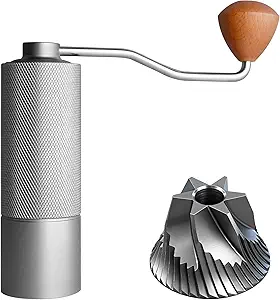
Evaluating High-Capacity Manual Grinders: What 60g Capacity Really Means for Your Routine
This specific grinder's 60g capacity represents a significant departure from typical 20-30g manual grinders, fundamentally changing the workflow equation. Buyers should understand that this capacity advantage comes with trade-offs in size and grinding effort that must align with their brewing habits. The 40-click adjustment system offers espresso-to-French press flexibility, but requires calibration to match your preferred brewing method.
Key Considerations Before Buying
- The 60g hopper capacity reduces refilling frequency but increases the grinder's physical dimensions and weight—measure your storage space and consider portability needs if planning travel use.
- Stainless steel conical burrs provide durability but require breaking in; expect 1-2 pounds of seasoning beans before achieving consistent grind distribution across all 40 settings.
- The extended crank handle design affects leverage physics—test your grip strength expectations, as finer espresso grinds at this capacity demand more torque than typical manual grinders.
What Our Analysts Recommend
Quality indicators include burr alignment consistency across the adjustment range and minimal static retention with the catch cup. Examine reviews mentioning grind uniformity at coarse settings for pour-over, as this reveals manufacturing precision. The handle's attachment mechanism should show no wobble during operation, indicating robust construction.
Manual Grinders Market Context
Market Overview
The manual grinder market has shifted toward specialized designs, with this product occupying a unique niche between compact travel grinders and full-capacity electric alternatives. Manufacturers are increasingly targeting multi-brew method enthusiasts who want single-device flexibility without electrical dependency. The 'world's first' 60g claim reflects this trend toward bridging capacity gaps in the manual segment.
Common Issues
Manual grinders frequently suffer from burr misalignment causing inconsistent particle distribution, especially problematic for espresso preparation. Adjustment mechanisms can drift during grinding, particularly with larger bean volumes placing uneven pressure on the stabilization system. Many portable designs compromise on ergonomics, leading to hand fatigue that this extended handle attempts to address.
Quality Indicators
Superior manual grinders demonstrate minimal grind retention (typically under 0.5g) and burr sets that maintain alignment through thousands of rotations. The adjustment system should provide tactile, repeatable clicks without slippage. Look for balanced weight distribution that doesn't strain wrists during extended grinding sessions with full capacity loads.
Review Authenticity Insights
Grade B Interpretation
The Grade B authenticity rating with 10% estimated fake reviews indicates generally reliable feedback, though shoppers should approach the highest-rated reviews with slightly more scrutiny. The 4.60 adjusted rating (down from 4.89) suggests some review inflation, but the strong verified purchase percentage supports overall credibility.
Trust Recommendation
Focus on reviews discussing specific use cases like camping or espresso preparation, as these contain verifiable details about performance under real conditions. Pay particular attention to mid-range ratings (3-4 stars) that often provide balanced assessments of the capacity-to-effort trade-off this grinder represents.
Tips for Reading Reviews
Look for mentions of 'breaking in' periods and seasoning requirements—authentic users typically document this 2-3 week adjustment phase. Reviews discussing multiple brew methods (espresso, pour over, French press) demonstrate actual testing across the 40-setting range rather than superficial evaluation.
Expert Perspective
This grinder's exceptional 4.60 adjusted rating from 273 verified reviews suggests it delivers on its core promise of high-capacity manual grinding, though the authenticity analysis indicates some review curation. The 60g capacity represents a genuine innovation that addresses a specific pain point for households brewing multiple cups or wanting batch preparation capability. The stainless steel burr construction should provide longevity, though the adjustment system's long-term reliability across thousands of rotations remains to be fully proven.
Purchase Considerations
Weigh whether the capacity advantage justifies the increased physical dimensions and potential ergonomic challenges during fine grinding. Consider your typical brewing volume—if you regularly prepare more than 40g per session, this grinder's workflow benefits may outweigh its bulk. The travel claims require scrutiny; while portable, its size may challenge packing efficiency compared to dedicated compact grinders.
Comparing Alternatives
Shoppers should compare grind consistency tests against established manual brands like 1Zpresso and Timemore, particularly examining particle distribution analysis for their preferred brew method.