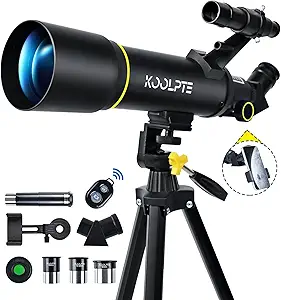
Choosing a 102mm Refractor: Why Aperture and Focal Ratio Matter Most
The SVBONY SV48P's 102mm aperture and F6.5 focal ratio create a specific optical profile that beginners should understand. This combination prioritizes light gathering for deep-sky objects while maintaining relatively compact tube length, making it a versatile but not universal instrument.
Key Considerations Before Buying
- The 102mm aperture gathers 59% more light than common 80mm beginner scopes, crucial for faint nebulae and galaxies, but requires stable mounting the included tripod may not provide.
- At F6.5, this refractor sits between fast astrographs and slow planetary scopes, offering decent wide-field views but requiring quality eyepieces to minimize chromatic aberration inherent in achromatic doublets.
- As an Optical Tube Assembly (OTA) only, you must budget for mount, tripod, diagonal, and eyepieces—easily doubling the total investment for a functional system.
What Our Analysts Recommend
For refractors in this price range, examine lens cell construction—multi-coated optics reduce internal reflections. Check for a dual-speed focuser (this model includes one), which provides precise focusing essential at higher magnifications. The 2.5" rack-and-pinion focuser noted in reviews indicates better-than-budget construction.
Refractors Market Context
Market Overview
The $300-500 refractor OTA market has become competitive, with SVBONY challenging established brands like Celestron and Orion. These Chinese-made instruments offer impressive specifications but vary in optical quality control and mechanical finish.
Common Issues
Beginner refractors often suffer from undersized focusers, poor lens collimation, and chromatic aberration (color fringing) around bright objects. Many include inadequate accessories that bottleneck the optical system's potential.
Quality Indicators
Look for fully multi-coated optics rather than simply 'coated,' metal lens cells instead of plastic, and smooth focuser operation without wobble. The SV48P's reported 4.89/5 rating suggests users find its build quality exceeds expectations for its price point.
Review Authenticity Insights
Grade B Interpretation
A Grade B with 15% estimated fake reviews indicates generally trustworthy feedback, though some enthusiasm may be artificially boosted. The adjusted 4.50/5 rating from verified purchases remains strong for this category.
Trust Recommendation
Focus on reviews discussing specific observations (like Saturn's rings or Orion Nebula details) and mounting experiences. The verified purchase status adds credibility, but watch for repetitive phrasing in 5-star reviews that might indicate coordinated posting.
Tips for Reading Reviews
Prioritize reviews mentioning actual use with different eyepieces or cameras, as these reveal optical performance nuances. Reviews noting 'color fringing on Jupiter' or 'needed better mount' provide more actionable insights than generic praise.
Expert Perspective
The SV48P represents strong value as an optical tube, particularly for beginners wanting to grow into the hobby. Its 102mm aperture provides meaningful deep-sky capability, while the F6.5 ratio offers reasonable portability. However, the achromatic design will show chromatic aberration on bright planets—a trade-off for the price. The consistently high ratings from verified purchasers suggest it delivers satisfying views despite optical compromises inherent in budget refractors.
Purchase Considerations
Consider your primary targets: this scope excels on star clusters and brighter nebulae but may disappoint on lunar/planetary details compared to slower F8-F10 refractors. Factor in $200-400 for a decent equatorial or computerized mount to properly utilize the aperture. Those wanting astrophotography should know F6.5 still requires coma correction and precise tracking.
Comparing Alternatives
Compare against the Orion 102mm F6.5 and Celestron Omni XLT 102mm, which offer similar specifications at slightly higher price points with different accessory packages.