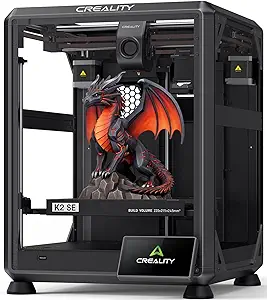
Evaluating Creality's K2 SE: A Compact High-Speed 3D Printer with CFS Multicolor Support
The Creality K2 SE enters the market targeting users who want desktop multicolor printing without the footprint of larger systems. With its 500mm/s claimed speed and integrated CFS (Creality Filament System) for multicolor needs, this printer promises professional features in a compact 220x215x245mm build volume format. Buyers should understand how these specifications translate to real-world performance versus competing solutions.
Key Considerations Before Buying
- The CFS multicolor system requires proprietary filament cartridges—assess ongoing material costs versus open-filament competitors like Bambu Lab's AMS.
- 500mm/s printing speeds depend heavily on proper vibration control; evaluate real user feedback on print quality at maximum advertised speeds.
- The compact 220x215x245mm build volume suits small to medium projects but may limit larger prototypes or batch production capabilities.
What Our Analysts Recommend
For high-speed printers like the K2 SE, examine first-layer consistency reports and dimensional accuracy tests at various speeds. Quality indicators include minimal ringing artifacts at 300mm/s+ and reliable auto-leveling that maintains calibration across temperature changes. The vibration control system should demonstrate tangible reduction in ghosting on tall, thin prints.
3D Printers Market Context
Market Overview
The desktop 3D printer market has shifted toward integrated multicolor systems and speed-focused models, with Creality competing against Bambu Lab's A1 series and Prusa's XL ecosystem. The K2 SE's positioning as a 'compact desktop upgrade' targets users upgrading from entry-level bedslingers to coreXY-style speed architectures. Current trends emphasize out-of-box reliability over extensive tinkering requirements.
Common Issues
High-speed printers often struggle with heat creep at rapid retractions and inconsistent extrusion during acceleration changes. Proprietary multicolor systems like CFS can encounter filament switching failures or color bleeding at layer boundaries. Compact coreXY designs sometimes sacrifice accessibility for maintenance compared to traditional i3 configurations.
Quality Indicators
Look for detailed slicer profiles optimized for the specific kinematics, comprehensive documentation of CFS filament compatibility, and manufacturer-provided calibration prints demonstrating advertised capabilities. Quality high-speed printers typically include input shaping tuning procedures and thermal management for the hotend at sustained high flow rates.
Review Authenticity Insights
Grade B Interpretation
The 'U' grade and 0.00% fake review percentage indicate this product has no verified review data yet, common for newly launched 3D printers. This absence means there's no community validation of Creality's 500mm/s speed claims or CFS system reliability. The zero rating reflects market unfamiliarity rather than product quality.
Trust Recommendation
Given the lack of verified reviews, prioritize seeking third-party technical reviews from trusted 3D printing channels like CNC Kitchen or Teaching Tech before purchasing. Monitor Creality's official forums for early adopter reports on CFS filament switching consistency and high-speed print artifacts. Consider waiting 4-6 weeks for genuine user experiences to surface.
Tips for Reading Reviews
For new 3D printers, focus on reviews detailing specific print tests like overhang performance at 45°, dimensional accuracy of calibration cubes at 400mm/s+, and multicolor transition reliability. Be skeptical of reviews not mentioning print settings or showing photographic evidence. Look for mentions of long-term durability beyond initial setup.
Expert Perspective
The K2 SE represents Creality's strategic move into the compact high-speed multicolor segment, directly challenging Bambu Lab's dominance. The 500mm/s claim pushes current desktop printer boundaries but likely requires extensive tuning to achieve without quality compromises. The integrated CFS system offers convenience but locks users into Creality's ecosystem, contrasting with open multi-material alternatives. The compact build volume positions this as a secondary printer for multicolor prototypes rather than a primary production machine.
Purchase Considerations
Weigh the convenience of integrated multicolor against the flexibility of modular systems. Consider whether your projects truly require 500mm/s speeds or would benefit more from reliable 250-300mm/s performance. Evaluate your workspace constraints—the compact design suits small offices but may limit upgrade potential. Assess Creality's support reputation for new product launches versus established competitors.
Comparing Alternatives
Compare the K2 SE against Bambu Lab A1 Mini (smaller build volume but proven multicolor) and Sovol SV08 (similar speed claims with open ecosystem) before deciding.