
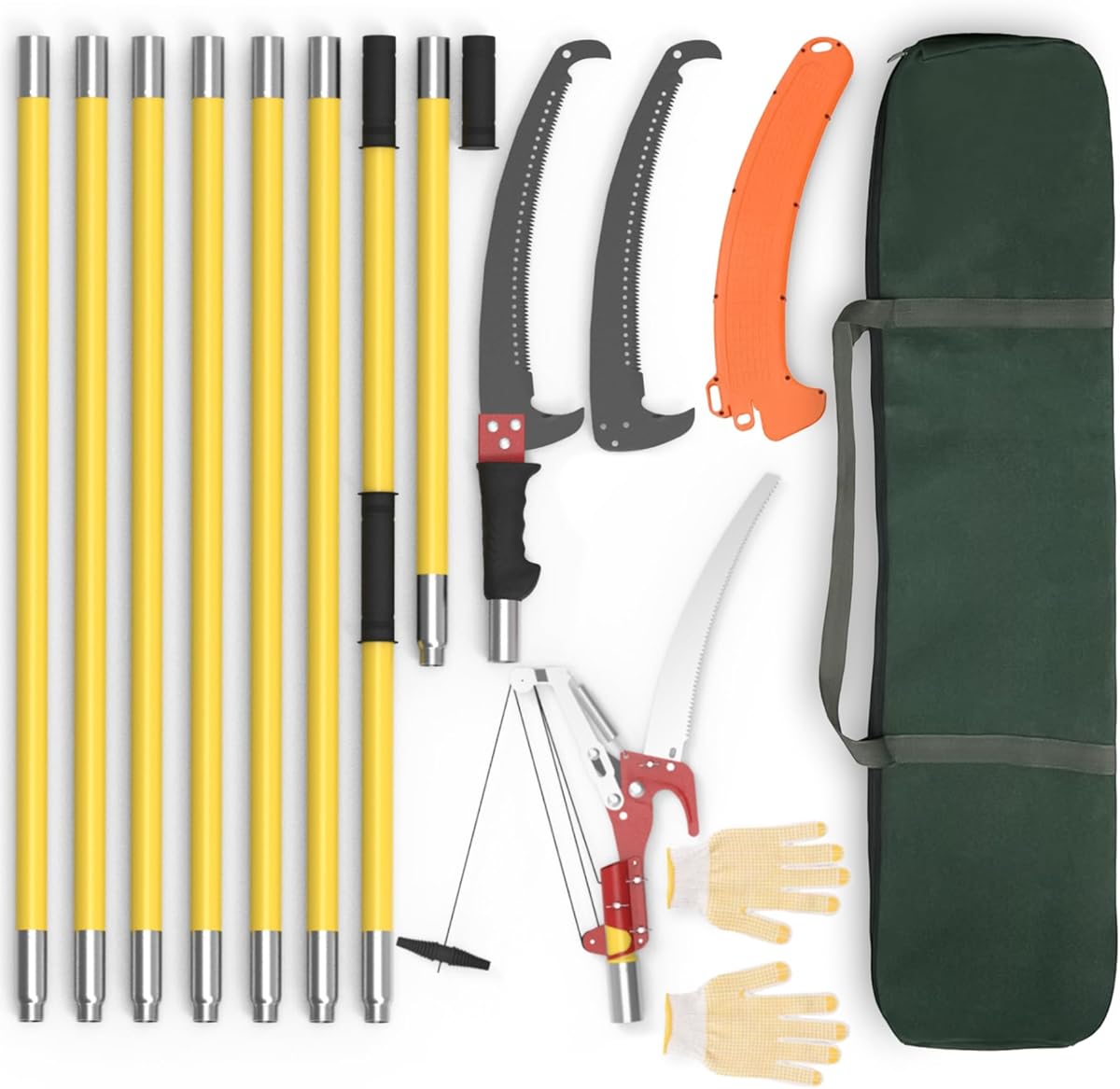
Extend Your Reach: Choosing a 7.3-27FT Pole Saw with Scissors
When tackling high branches on mature trees, a manual pole saw like the 7.3-27FT Extendable Long Handle Pole Saw offers a safe, ladder-free solution. This tool combines a pruning saw with branch scissors, making it versatile for both cutting and trimming tasks. Understanding how reach, blade quality, and cutting mechanism affect performance is key to a successful purchase.
Key Considerations Before Buying
- Assess the maximum reach needed for your trees; a 27-foot extension is ideal for tall branches but can be unwieldy in tight spaces, so consider the collapsed length for storage and maneuverability.
- Evaluate the cutting mechanisms: the included saw blade handles thicker limbs (up to several inches), while branch scissors excel on smaller, green growth—ensuring you have the right tool for different branch sizes without switching tools.
- Check the locking mechanism and pole material; a sturdy aluminum or fiberglass pole with secure locks prevents slippage during use, especially at full extension, reducing fatigue and improving cutting accuracy.
What Our Analysts Recommend
Look for a pole saw with a sharp, replaceable blade (often triple-ground teeth for efficient cutting) and ergonomic handles with non-slip grips. The branch scissors should have a spring-loaded return for ease of use, and the pole should feature twist-lock or cam-lock mechanisms that hold firmly under pressure.
Manual Pole Saws Market Context
Market Overview
The manual pole saw market has expanded with telescopic designs that offer extended reach without heavy engines, appealing to homeowners who prefer quiet, eco-friendly tools. Many models now integrate features like branch scissors and rotating heads to improve versatility, though durability and locking reliability vary widely among budget options.
Common Issues
Common problems include pole sections that loosen during use, blades that dull quickly on hardwood, and scissors that jam on thick, fibrous stems. Users also report difficulty in aligning the saw blade at certain angles, especially when working overhead for extended periods.
Quality Indicators
High-quality manual pole saws feature hardened steel blades with impulse-hardened teeth, reinforced aluminum poles with anodized finishes to resist corrosion, and precision-engineered locking collars that provide a secure connection. A comfortable, ergonomic grip and a lightweight but rigid pole are signs of superior design.
Review Authenticity Insights
Grade B Interpretation
The Grade B rating and 10% estimated fake review rate indicate that while the majority of reviews are genuine, a small but notable portion may be artificially boosted. This suggests the product's 4.67-star average is slightly inflated; the adjusted rating of 4.40 is a more realistic benchmark of customer satisfaction.
Trust Recommendation
Given the 90% authentic reviews, you can generally trust the positive feedback, but focus on verified purchase reviews with specific details about long-term use. Be cautious of overly brief or excessively glowing reviews without mention of specific features like reach or cutting performance.
Tips for Reading Reviews
When reading reviews, prioritize those that describe real-world scenarios, such as cutting specific tree types (e.g., oak, pine) or using the pole at full extension. Look for comments on blade sharpness after multiple uses and the scissors' ability to handle branches up to 1 inch thick—these details signal genuine experience.
Expert Perspective
The 7.3-27FT Extendable Long Handle Pole Saw stands out for its dual-function design, combining a pruning saw and branch scissors in one tool—a practical feature for homeowners who need to clear both large and small branches without ladder climbing. With a strong 4.40 adjusted rating and mostly authentic reviews, it appears to deliver on its promise of extended reach and versatility. However, the 10% fake review rate suggests some marketing hype, so weigh the positive feedback against potential durability concerns with the locking mechanism over time.
Purchase Considerations
Consider your typical branch sizes and tree heights: if you frequently cut limbs over 3 inches thick, ensure the saw blade is robust enough; if you mainly trim small growth, the scissors will be your primary tool. The pole's weight at full extension may cause fatigue, so test the balance if possible, and ensure the scissors' spring mechanism feels smooth and durable.
Comparing Alternatives
Shoppers should compare this model with fixed-length pole saws for lighter weight and simpler construction, or with powered pole pruners for easier cutting on very thick branches, though those add cost and maintenance.


