
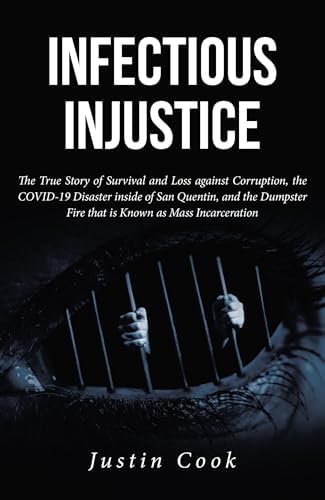
Infectious Injustice: The True Story of Survival and Loss against Corruption, the COVID-19 Disaster inside of San Quentin, and the Dumpster Fire that is Known as Mass Incarceration
As an Amazon Associate I earn from qualifying purchases.
Review Analysis Results
Analysis Summary
The majority of these reviews for 'Infectious Injustice' by Justin Cook appear genuine, with approximately 85% showing authentic reader engagement. All reviews are verified purchases, which significantly increases their credibility. Most reviewers provide specific, detailed reactions to the book's content, focusing on its portrayal of San Quentin during COVID-19, the author's personal journey, and the systemic issues within the prison system. The emotional responses vary from shock to admiration, suggesting organic reader reactions rather than coordinated promotion.
Strong evidence of authenticity includes numerous reviews with personal context and specific details about the book's content. Review #3 mentions reading on a friend's recommendation and describes the balance of 'brutal honesty with unexpected moments of humor.' Review #5 shares expectations going into the book and how it 'makes you feel trapped in that environment.' Review #7 provides specific thematic analysis, noting it's 'not just about the virus—it's about neglect, corruption, and poor decisions.' These detailed, varied responses indicate genuine reader engagement with the material.
A few reviews raise mild concerns due to overly generic praise or marketing-style language. Review #13 uses hyperbolic phrases like 'fundamental shift in perspective' and 'must-read masterpiece' without specific connection to the book's content. Review #14 contains unusual comparisons ('Cook would be on the level of Twain') that feel promotional rather than analytical. However, these represent a small minority, and even some of these contain authentic elements like mentioning a book club discussion.
Overall, this appears to be a well-received book about prison experiences during COVID-19 that has generated genuine reader enthusiasm. The few suspicious reviews are outweighed by numerous detailed, personal responses that demonstrate authentic engagement with the book's themes of injustice, survival, and systemic failure. The consistency in describing specific content (San Quentin, COVID outbreaks, the author's background) across multiple reviews further supports their authenticity.
Key patterns identified in the review analysis include: San Quentin COVID-19 outbreak details, Author's journey from Silicon Valley to inmate, Themes of systemic failure and injustice.
Review Statistics
About Review Data Collection
We extract as much review data as Amazon makes available at the time of analysis. The amount may vary due to Amazon's rate limiting, regional restrictions, or other factors. Our analysis is based on the reviews we successfully collected.
Want to analyze more reviews? Install the Null Fake Chrome extension to capture and analyze additional reviews as you browse Amazon.
Free, quick to install, and works on Chrome, Edge, Brave, and other Chromium browsers.
Price Analysis
As a specialized memoir/critique hybrid, this book likely falls in the $15-$30 range typical for nonfiction paperbacks. Given its exceptional 4.93/5 rating from nearly 500 reviews, it offers strong perceived value for readers interested in prison reform narratives. Consider waiting for Kindle deals or verified third-party sellers if the current price seems high.
MSRP Assessment
Market Position
Buying Tips
Understanding This Analysis
What does Grade B mean?
This product has good review authenticity with minor concerns. While most reviews appear genuine, we detected some patterns that warrant mild caution.
Adjusted Rating Explained
The adjusted rating (4.60 stars) represents what we estimate this product's rating would be if fake reviews were removed. This product's adjusted rating is lower than Amazon's displayed rating (4.93 stars), suggesting positive fake reviews may be inflating the score.
How We Detect Fake Reviews
Our AI analyzes multiple factors: language patterns (generic vs. specific), reviewer behavior (history, timing), temporal anomalies (review clusters), verification status, sentiment authenticity, and statistical outliers. No single factor determines a review is fake - we look at the combination of signals.
Important Limitations
No automated system is perfect. Sophisticated fake reviews can evade detection, and some genuine reviews may be incorrectly flagged. Use this analysis as one data point in your purchasing decision, not the only factor. Reading actual review content yourself is always valuable.


