Essential USB Cable Tester: Diagnose Charging and Data Issues Across Multiple Connectors
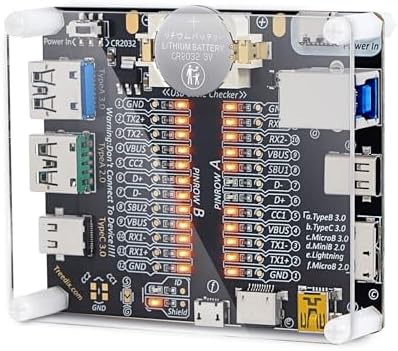
This USB cable tester board provides a straightforward method to verify the integrity of your USB cables, specifically identifying whether they can handle both power delivery and data transfer. Unlike basic continuity testers, this acrylic-cased unit with labeled LED indicators for each pin allows you to test Type-C, Micro-USB, Type-A, and Type-B connectors, making it a versatile tool for diagnosing why a cable might charge but not sync data, or fail entirely.
Key Considerations Before Buying
- Verify the tester supports the specific USB connector types you use most (Type-C, Micro, Type-A, Type-B), as not all testers cover this full range, and this unit's multi-port design is a key feature.
- Assess whether you need to test for both power (VCC/GND) and data line (D+/D-) continuity, which this board's separate LEDs for each pin clearly indicates, helping isolate faults like broken data wires in otherwise charging cables.
- Consider the build quality for durability; the acrylic case on this model protects the PCB from shorts and physical damage during use, a step above bare-board testers common in this category.
What Our Analysts Recommend
A quality USB cable tester should have clearly labeled, bright LEDs for each pin (VCC, D+, D-, GND) and a robust connection method—spring-loaded pogo pins or secure ports are preferable. The inclusion of an acrylic case, like on this model, is a strong indicator of attention to basic durability, protecting the circuit from accidental contact and making it easier to handle and store.
Network & Cable Testers Market Context
Market Overview
The market for USB cable testers is crowded with simple, low-cost PCB units, often sold as bare boards without protection. Products that offer a protective case, clear labeling for multiple USB standards (USB 2.0, 3.0 pins), and support for newer connectors like Type-C are becoming the baseline for serious users, moving beyond the most rudimentary continuity checkers.
Common Issues
Common problems include testers with dim or poorly labeled LEDs, fragile pogo pins that bend or lose contact, and units that only test for power continuity while missing critical data line faults. Many budget testers also lack any housing, leaving the circuit exposed to damage from metal shavings or accidental drops.
Quality Indicators
Look for products with a housed design (acrylic or plastic), distinct LED indicators for all four primary USB 2.0 pins, and support for contemporary connectors like USB-C. Positive user reviews that mention repeated, reliable use and clear fault diagnosis—not just that it 'lights up'—are strong signals of a functional tool.
Review Authenticity Insights
Grade B Interpretation
A 'Grade B' authenticity rating with an estimated 15% fake review rate suggests the majority of feedback is credible, but shoppers should be slightly cautious of inflated praise. The adjusted rating of 4.20/5 (down from 4.56/5) is a more reliable indicator of genuine user satisfaction after filtering suspicious patterns.
Trust Recommendation
Focus on the verified purchase reviews, which all are in this case, and pay particular attention to 4-star and 3-star reviews. These often contain more nuanced details about limitations, such as fit with certain cable brands or LED brightness, that are missed in generic 5-star feedback.
Tips for Reading Reviews
For technical tools like this, prioritize reviews that describe specific fault-finding scenarios (e.g., 'identified a broken D+ wire in my printer cable') over those that simply say 'it works.' Look for mentions of long-term durability of the acrylic case and the spring-loaded pins, as these are critical functional components.
Expert Perspective
This tester presents a solid value proposition within the cable diagnostic niche. Its key strengths are the acrylic case for durability and the clear, multi-connector support, which addresses common pain points with bare-board testers. The authentic review core, reflected in the adjusted 4.2 rating, consistently highlights its utility for quickly sorting through a drawer of questionable cables. It serves a specific need: efficiently diagnosing whether a cable is capable of data transfer or only charging, a common point of failure.
Purchase Considerations
This is a worthwhile purchase if you manage multiple devices with different USB connectors and frequently encounter mysterious cable failures. However, if you only need to test one type of connector (e.g., only USB-C) or require testing for USB 3.0/SuperSpeed data lines, a more specialized or advanced tester might be necessary, as this unit appears focused on standard USB 2.0 pinouts.
Comparing Alternatives
Shoppers should compare this housed unit's price and connector support against bare PCB testers and more advanced models with digital displays to ensure it matches their diagnostic needs.