
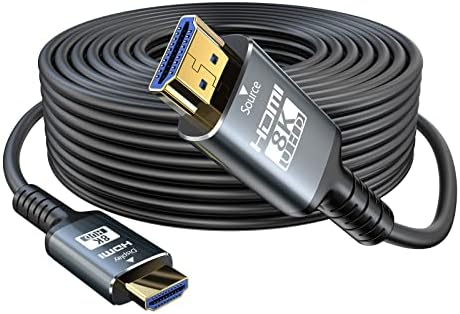
Choosing a 75-Foot Fiber HDMI 2.1 Cable for 8K and In-Wall Installations
When you need to run an HDMI signal 75 feet, standard copper cables won't cut it—they often suffer from signal degradation at such lengths. This is where a fiber optic HDMI 2.1 cable, like the one rated CL3 for in-wall use, becomes essential for maintaining 48Gbps bandwidth and supporting 8K@60Hz or 4K@120Hz. Buyers should understand that fiber HDMI cables are a specialized solution for long runs, offering reliability but at a higher cost than shorter copper alternatives.
Key Considerations Before Buying
- Length and Signal Integrity: At 75 feet, only fiber optic cables can reliably transmit 48Gbps for 8K content without loss or interference, making this a must for long runs from a media closet to a projector or large TV.
- In-Wall Rating (CL3): If you're routing the cable through walls or ceilings, a CL3 rating is critical for safety and code compliance, as it ensures the cable's jacket resists fire and meets building standards.
- Compatibility with Modern Gear: Ensure the cable supports HDMI 2.1 features like VRR (variable refresh rate) for gaming on PS5 or RTX 3080/3090, and eARC for high-quality audio passthrough from your TV to a soundbar.
What Our Analysts Recommend
Look for a cable that explicitly lists 48Gbps bandwidth, as lower-rated fiber cables may not handle 8K or 4K@120Hz. Also, verify HDCP 2.2/2.3 compliance to prevent copy-protection issues with streaming services or Blu-ray players, and check for a warranty that covers the fiber optics, which can be more delicate than copper.
HDMI Cables Market Context
Market Overview
The fiber HDMI cable market has grown rapidly with the adoption of 8K TVs and high-end gaming, but many cables on Amazon claim 48Gbps without delivering due to poor construction or outdated chipsets. This category is dominated by brands like RUIPRO and Cable Matters, though generic options often lack consistent quality control.
Common Issues
Common issues include cables not achieving full 48Gbps speeds at long lengths, compatibility problems with certain TV or GPU ports, and fiber optic cables that fail due to bending or sharp installation angles. Some users also report HDCP handshake errors, especially with older devices.
Quality Indicators
Quality is indicated by a thick, durable jacket (often with a braided or PVC exterior), clear labeling of HDMI 2.1 and CL3 ratings, and positive reviews from users with similar setups (e.g., projectors, in-wall runs). Look for cables with a chipset that supports dynamic HDR and VRR, as these are harder to implement reliably.
Review Authenticity Insights
Grade B Interpretation
With a Grade B and an estimated 10% fake review rate, this product's reviews are largely trustworthy, but you should be cautious of a small subset of overly enthusiastic or vague 5-star ratings. The 4.44 overall rating (adjusted to 4.20) suggests the product performs well but may not be perfect for every user.
Trust Recommendation
Given the authenticity grade, you can generally trust the positive feedback, but prioritize reviews that describe specific setups (e.g., '75-foot run to a Sony A80J' or 'works with RTX 3090 at 4K 120Hz'). These are more likely genuine and provide actionable insights for your own installation.
Tips for Reading Reviews
For a 75-foot fiber HDMI cable, focus on reviews that mention the exact length and devices used, and look for any mentions of signal drops, flickering, or compatibility issues. Avoid reviews that only say 'works great' without context, as these may be incentivized.
Expert Perspective
This fiber HDMI 2.1 cable is a solid choice for long-distance 8K runs, with a strong rating and mostly authentic reviews backing its performance at 75 feet. The CL3 rating adds value for in-wall installations, and the support for eARC and VRR makes it versatile for both home theater and gaming. However, the 10% fake review rate means it's not flawless, and some users may encounter issues with specific devices or installation angles.
Purchase Considerations
Weigh the cost against cheaper copper HDMI cables (which won't work at this length) and consider whether you truly need 8K support or if a 4K@60Hz fiber cable could save money. Also, ensure your devices have HDMI 2.1 ports to fully leverage the 48Gbps bandwidth, or you'll be paying for unused capability.
Comparing Alternatives
Shoppers should compare this cable with other fiber HDMI 2.1 options from brands like RUIPRO or Monoprice, especially if you need a longer run (e.g., 100 feet) or want a slimmer cable for easier routing through conduits.
![UANTIN USB C to HDMI Cable 6Ft | 4K High-Speed USB 3.1 Type-C to HDMI Cord [Thunderbolt 3/4/5 Compatible] with MacBook, Galaxy S9 to S24, iPhone 15/16, iPad Pro, iMac, Surface : Electronics](https://m.media-amazon.com/images/I/41PCWGGiE1L._SX342_SY445_QL70_FMwebp_.jpg)


