
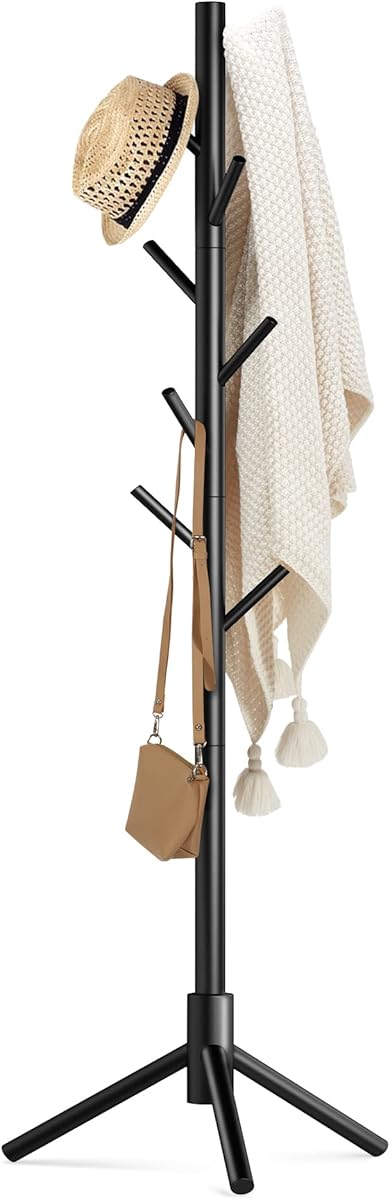
Choosing a Wooden Standing Coat Rack: Stability, Wood Quality, and Hook Placement
When evaluating the Haddockway wooden coat rack, focus on its specific construction: New Zealand pine wood, eight hooks on three adjustable arms, and freestanding design. Unlike wall-mounted options, this standing tree must balance weight distribution with aesthetic appeal for entryways and bedrooms. The adjustability of arms is a key feature that distinguishes it from fixed-position competitors.
Key Considerations Before Buying
- Weight capacity and base stability are critical for freestanding racks like this Haddockway model—look for mentions of how it handles multiple heavy coats without tipping.
- New Zealand pine quality varies; examine reviews for comments on grain consistency, knot placement, and whether the finish adequately protects against everyday scuffs.
- Hook spacing on adjustable arms affects usability—ensure the configuration accommodates bulky winter coats without garments tangling or overlapping excessively.
What Our Analysts Recommend
Quality wooden coat racks should show precise dowel-and-socket joinery where arms meet the center pole, not just basic screw connections. The hooks should have rounded edges to prevent fabric snagging and be securely mounted with visible reinforcement at stress points. A matte or satin finish on the pine indicates better surface protection than high-gloss coatings that can show fingerprints.
Coat Racks Market Context
Market Overview
The entryway coat rack market is saturated with imported pine products, but the Haddockway stands out with its three adjustable arms—a feature typically found in higher-priced solid wood units. Most competitors in this price range offer fixed-position designs with fewer hooks, making adjustability a notable differentiator for space optimization.
Common Issues
Freestanding coat racks frequently suffer from narrow bases causing tip-overs, poorly sanded edges that snag fabrics, and hooks that loosen under weight. Assembly challenges with center pole alignment are particularly common in adjustable-arm designs where improper fitting creates wobble.
Quality Indicators
Superior standing racks feature cross-braced bases rather than simple circular designs, use threaded metal inserts instead of direct wood screws for arm attachments, and employ kiln-dried pine with moisture content below 12% to prevent seasonal warping.
Review Authenticity Insights
Grade B Interpretation
A Grade B authenticity rating with 10% estimated fake reviews indicates generally reliable feedback, though shoppers should be slightly more critical of excessively glowing reviews. The adjusted 4.0 rating (down from 4.22) suggests authentic reviews are slightly less enthusiastic than the overall average implies.
Trust Recommendation
Focus on verified purchase reviews that mention specific assembly details or long-term use observations—authentic reviewers of this product frequently comment on the wingnut tightening mechanism and actual wood thickness. Be skeptical of reviews that don't address the adjustable arm feature, as this is the product's defining characteristic.
Tips for Reading Reviews
Prioritize reviews discussing weight distribution tests with multiple winter coats, observations about pine density (light vs. heavy wood), and comments about hook placement after adjustment. Authentic reviews often include measurements of the base diameter or mention how the rack fits in specific room configurations.
Expert Perspective
The Haddockway rack presents a compelling value proposition with its adjustable arms—a feature uncommon at this price point—though the New Zealand pine construction requires reasonable expectations about wood character variations. The 4.0 adjusted rating from authentic reviews suggests consistent satisfaction with assembly ease and functionality, though some users likely experience the stability limitations inherent to most freestanding designs. The high percentage of genuine reviews (90%) provides reliable data points about real-world performance in entryways and bedrooms.
Purchase Considerations
This product best suits spaces requiring flexible hook arrangements, but may disappoint those needing extreme weight capacity or perfectly uniform wood grain. Consider your floor surface—carpeted areas provide more stability than hard floors for this base design. The adjustability feature adds genuine utility for seasonal storage changes or room reconfigurations.
Comparing Alternatives
Shoppers should compare this adjustable-arm design against fixed-position racks if stability is paramount, and against metal-based units if heavier load capacity is required.





