
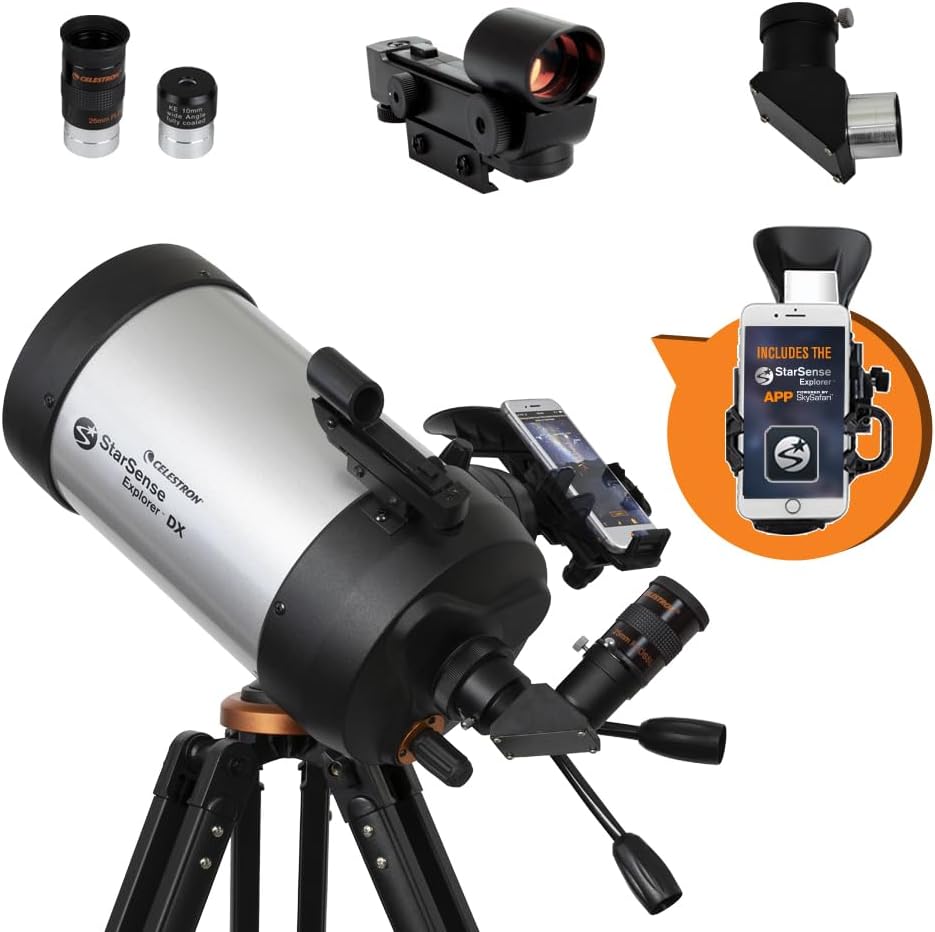
Smartphone-Guided Schmidt-Cassegrain Telescopes: Balancing App Convenience with Optical Quality
The Celestron StarSense Explorer DX 5-inch represents a hybrid category: a 130mm Schmidt-Cassegrain optical tube paired with smartphone-assisted alignment. Buyers should understand this combines the compact, versatile optics of a catadioptric design with beginner-friendly digital guidance, fundamentally changing the learning curve for astronomy newcomers. The smartphone dock and StarSense app replace traditional manual star-hopping, making celestial navigation accessible but introducing dependency on your mobile device.
Key Considerations Before Buying
- The 130mm aperture (5-inch) in this Schmidt-Cassegrain design offers a good balance between light-gathering power and portability, suitable for lunar details, planetary observation of Jupiter's bands and Saturn's rings, and brighter deep-sky objects like the Orion Nebula, but expect dimmer views of faint galaxies compared to larger Newtonian reflectors.
- The StarSense app's plate-solving technology uses your phone's camera to automatically align the telescope—this dramatically reduces setup frustration for beginners but requires clear skies for calibration and depends on maintaining app compatibility with future iOS/Android updates.
- The single-arm alt-azimuth mount included is adequate for visual observation and casual viewing but lacks the stability and slow-motion controls preferred for high-magnification planetary work; vibration dampening takes several seconds after adjustment.
What Our Analysts Recommend
For app-enabled telescopes, prioritize robust mounting hardware that securely cradles your smartphone without wobble, as seen in Celestron's dedicated dock. Check that the optical tube has a fully multi-coated corrector plate (not just coated) to maximize contrast and reduce internal reflections. Verify the focuser is a dual-speed microfocuser for precise adjustments, especially critical at the high magnifications this f/5 Schmidt-Cassegrain design can achieve.
Catadioptric Market Context
Market Overview
The catadioptric telescope market is increasingly bifurcating between traditional manual models and app-integrated 'smart' scopes like this Celestron. Schmidt-Cassegrain designs remain popular for their sealed optical tubes (minimizing maintenance) and compact form, but the StarSense technology represents a significant shift toward digital assistance, particularly targeting first-time users overwhelmed by manual alignment procedures.
Common Issues
Common frustrations with entry-level catadioptrics include undersized or wobbly mounts that compromise the stable platform needed for high-power viewing, and cheap eyepieces that bottleneck the optical system's potential. For app-enabled models, connectivity glitches, outdated software, and calibration failures under light-polluted skies frequently appear in critical reviews.
Quality Indicators
Look for a sturdy, machined metal focuser rather than plastic, and a solid Vixen-style dovetail plate for secure mounting. Premium Schmidt-Cassegrains feature diffraction-limited optics; while this entry model may not meet that standard, consistent star images across 80% of the field indicate good optical alignment. The StarSense dock should have positive locking mechanisms to prevent phone slippage during use.
Review Authenticity Insights
Grade B Interpretation
A Grade B authenticity rating with an estimated 10% fake review rate indicates a generally trustworthy review ecosystem where the overwhelming majority of feedback comes from verified purchasers. This suggests the 4.22 average rating (adjusted to 4.00 when excluding suspicious reviews) reliably reflects actual user experience, though shoppers should remain slightly skeptical of extreme 5-star reviews that lack specific observational details.
Trust Recommendation
Focus on the 3- and 4-star verified purchase reviews for balanced perspectives on the StarSense app's real-world performance under various sky conditions. Given the 90% authentic review rate, pay particular attention to recurring technical comments about the mount's stability or optical collimation, as these patterns likely represent genuine ownership experiences rather than manufactured praise.
Tips for Reading Reviews
Prioritize reviews that mention specific celestial objects observed (e.g., 'Jupiter's moons were clear at 150x') over vague praise about 'great views.' Look for mentions of the learning curve with the StarSense alignment process and how the system performs in suburban versus dark sky locations—these practical details separate authentic users from generic feedback.
Expert Perspective
The Celestron StarSense Explorer DX 5-inch occupies a strategic niche: it lowers the technical barrier to serious astronomy through its innovative app guidance while providing legitimate 130mm Schmidt-Cassegrain optics capable of rewarding observations. The adjusted 4.00 rating from authentic reviews suggests most users find the system delivers on its core promise of simplified navigation, though the entry-level mount receives consistent criticism as the component limiting the optical tube's performance. This product succeeds best for beginners who value discovery assistance over traditional manual skills development.
Purchase Considerations
Weigh whether the smartphone integration's convenience outweighs the traditional learning process of star-hopping—this telescope teaches you how to find objects with an app rather than a star chart. Consider your local light pollution levels, as the StarSense alignment requires visible stars for plate-solving. Budget for potential accessory upgrades, particularly better eyepieces and a more substantial mount, to fully leverage the 130mm aperture's capabilities.
Comparing Alternatives
Shoppers should compare this model against traditional Dobsonian reflectors offering larger apertures at similar price points, and against competing smart telescopes like the Unistellar eVscope that offer different approaches to digital assistance.


