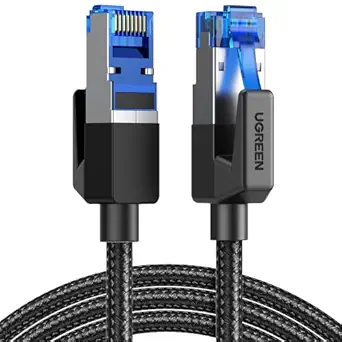
When to Choose a 100ft Cat8 Cable Over Standard Options for Your Network
This specific Cat8 cable offers 40Gbps speeds and 2000MHz bandwidth, but its 100ft length and direct burial rating create unique considerations. Buyers should understand that achieving Cat8's full potential requires compatible hardware, and this heavy-duty construction addresses specific installation challenges rather than typical home networking needs.
Key Considerations Before Buying
- The 26AWG gauge on this cable provides better signal integrity over its 100ft length compared to thinner cables, but requires more careful handling during installation due to reduced flexibility.
- Direct burial capability means this cable has superior waterproofing and UV-resistant jacketing, making it suitable for outdoor runs between buildings or underground installations where standard indoor cables would fail.
- SFTP (Shielded Foiled Twisted Pair) shielding provides excellent interference protection, but requires properly grounded connections to be effective and adds to the cable's stiffness and diameter.
What Our Analysts Recommend
For this product category, examine the RJ45 connector quality—gold-plated contacts should be visible and securely molded to the cable. The weatherproof rating should be explicitly stated for outdoor use, and the cable should maintain consistent thickness without kinks or weak points along its 100ft length, indicating proper copper quality and shielding integrity.
Cat 7 Cables Market Context
Market Overview
The Cat7/Cat8 cable market is flooded with exaggerated claims, particularly regarding speed ratings that most consumer equipment cannot utilize. This specific product sits in a niche between professional installations and high-end home networking, with its 100ft length and direct burial features targeting users with complex setup requirements.
Common Issues
Many buyers purchase Cat8 cables without understanding that their routers, modems, or gaming consoles lack the necessary ports to support beyond 1Gbps speeds. Another frequent problem involves improper termination of shielded cables, which can create ground loops and actually degrade performance rather than improve it.
Quality Indicators
Genuine quality in this category shows in the connector strain relief design, the clarity of printing on the cable jacket indicating certification standards, and the consistency of the twist pattern visible at cable ends. Heavy-duty cables should have substantial but not excessive jacket thickness that balances durability with manageable installation.
Review Authenticity Insights
Grade C Interpretation
The Grade C authenticity rating and 22% estimated fake reviews indicate that while most feedback appears genuine, nearly one-quarter of reviews may be artificially positive. This discrepancy between the 4.78 advertised rating and adjusted 4.30 rating suggests some review manipulation around this specific product.
Trust Recommendation
Focus on reviews that mention specific installation scenarios like burying the cable, running it through walls, or connecting particular equipment like high-end routers or network switches. Be skeptical of reviews that only praise speed increases without detailing their previous setup or testing methodology.
Tips for Reading Reviews
Prioritize reviews discussing the cable's physical characteristics—stiffness, connector fit, jacket durability—over generic speed claims. Look for users who mention using cable testers or who describe overcoming specific interference issues, as these indicate technical understanding rather than marketing repetition.
Expert Perspective
This cable represents a specialized solution for specific scenarios: long-distance runs between buildings, installations requiring burial, or environments with significant electromagnetic interference. The 26AWG construction is appropriate for 100ft lengths to minimize signal attenuation, though it makes the cable less flexible than standard 28AWG options. The SFTP shielding is genuinely beneficial for outdoor or industrial environments but unnecessary for typical home office setups. The product's value lies in its durability ratings rather than its Cat8 specifications, which most users cannot fully utilize.
Purchase Considerations
Only consider this cable if you genuinely need weatherproofing, direct burial capability, or are running cable through areas with significant interference. For standard indoor use under 100ft, less expensive Cat6 or Cat6a cables provide identical performance with greater flexibility and easier installation. Verify that your network equipment has appropriate ports before expecting 40Gbps speeds.
Comparing Alternatives
Shoppers should compare this against professional-grade Cat6a cables with similar outdoor ratings, as they often provide better value for most real-world applications.