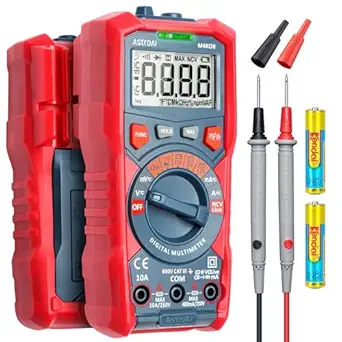
Crenova MS8233D: True RMS Accuracy Without the Premium Price
The Crenova MS8233D targets DIYers and hobbyists who need true RMS (TRMS) readings and a 6000-count display without spending Fluke-level money. With auto-ranging, live wire NCV detection, and a 4.89-star average across 9,126 reviews, it's one of the most-reviewed budget multimeters in the U.S. market.
Key Considerations Before Buying
- TRMS vs. average-sensing: True RMS matters when measuring non-sinusoidal AC loads like dimmers, VFDs, or modern electronics; a cheaper averaging meter will give you misleading voltage readings on those circuits.
- 6000-count resolution: This resolution gives you roughly 10x finer granularity than a basic 2000-count meter, so you can distinguish 12.47V from 12.52V on a battery or low-voltage circuit.
- Safety rating awareness: Budget meters often lack the CAT III/IV ratings needed for industrial or panel-level work; the MS8233D is best suited to household, automotive, and low-voltage bench tasks.
What Our Analysts Recommend
Prioritize meters with genuine TRMS chipsets, fused inputs, and a clear CAT rating printed on the housing rather than just the manual. Check whether the test leads are silicone-insulated with proper strain relief, since flimsy leads are the most common failure point on sub-$50 meters. A backlit display and audible continuity beeper are practical must-haves that separate usable budget meters from frustrating ones.
Multi Testers Market Context
Market Overview
The sub-$50 multimeter market is crowded with no-name brands, but a handful—Crenova, AstroAI, Klein—have built reputations on consistent QC and honest spec sheets. True RMS and 6000-count features, once premium-only, are now table stakes at this price point, which has compressed margins and pushed differentiation toward build quality and safety ratings.
Common Issues
The most frequent complaints in this category are inaccurate readings at low voltages, leads that break within months, and vague or misleading CAT safety claims. Auto-ranging meters can also be slower to settle than manual-range units, which frustrates users doing repetitive measurements.
Quality Indicators
Look for published accuracy specs (±% + digits), a real fuse you can replace, and a rubberized or drop-resistant housing. Brands that publish calibration certificates or offer a multi-year warranty are signaling confidence in their QC. A high review count with a stable rating over several years is a stronger signal than a spike of recent five-star reviews.
Review Authenticity Insights
Grade A Interpretation
An A grade with only 5.00% estimated fake reviews means the 4.89-star rating reflects genuine user sentiment rather than a manufactured score. For a product with 9,126 reviews, that's unusually clean—most budget electronics categories run 10–20% suspicious reviews, so this analysis suggests you can trust the aggregate rating.
Trust Recommendation
Use the 4.80 adjusted rating as your realistic expectation: it's still excellent, and the small drop from 4.89 is a healthy sign that the analysis is conservative rather than lenient. Read the 1- and 2-star reviews specifically for patterns around leads, accuracy drift, or fuse failures, since those are the failure modes that matter most on a multimeter.
Tips for Reading Reviews
Prioritize reviews that mention specific measurements, model comparisons, or long-term use (6+ months) over short 'works great' posts. Look for reviewers who describe their use case—automotive, HVAC, hobby electronics—because a meter that's fine for a homeowner may be inadequate for a technician. Ignore reviews that only praise shipping speed or packaging.
Expert Perspective
The Crenova MS8233D sits in the sweet spot for a first serious multimeter: TRMS, 6000 counts, auto-ranging, and NCV at a price that undercuts name-brand equivalents by 50% or more. The 4.89/5 rating across 9,126 reviews, with an A authenticity grade, is about as strong a signal as you'll find in the budget test-equipment space. For household wiring checks, automotive diagnostics, and bench prototyping, it covers the vast majority of real-world tasks. It is not a substitute for a CAT III/IV-rated meter if you're working on industrial panels or service entrances.
Purchase Considerations
Weigh your actual use case: if you're a homeowner or hobbyist, this meter delivers 90% of the functionality of a $150 meter for a fraction of the cost. If you're a professional electrician working on live panels, spend more on a CAT III/IV-rated unit from Fluke, Klein, or Ideal. Also factor in lead quality—budget a few dollars for upgraded silicone leads if you plan heavy use.
Comparing Alternatives
Compare the MS8233D against the AstroAI 6000-count and Klein Tools MM325, which offer similar specs with different warranty and support terms. The right choice depends on whether you value lowest price, brand support, or specific features like temperature measurement.