
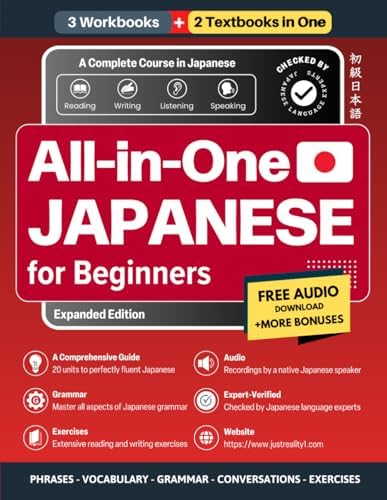
Master Japanese from Scratch: What This All-in-One Workbook Set Offers
For beginners tackling Japanese, the challenge often lies in balancing script learning (Hiragana, Katakana, Kanji) with grammar and vocabulary. This 5-book set combines three workbooks and two textbooks to provide a structured, step-by-step approach that covers reading, writing, and speaking. Understanding how this resource integrates these components can help you decide if it fits your learning style.
Key Considerations Before Buying
- Consider whether you prefer a single comprehensive set versus separate resources for each script; this all-in-one approach reduces the need for multiple purchases but may feel overwhelming if you want to focus on one area at a time.
- Evaluate the balance between workbook exercises and textbook explanations: workbooks emphasize practice (e.g., writing characters, fill-in-the-blank), while textbooks provide grammar rules and vocabulary lists—this set includes both, so you get theory and application.
- Check if the content aligns with your goals: if you aim to speak conversationally, look for audio support or dialogue exercises; this set focuses on written exercises, so you may need supplementary listening practice.
What Our Analysts Recommend
Quality indicators for beginner language sets include clear script stroke order diagrams, progressive difficulty in exercises, and inclusion of common vocabulary (e.g., greetings, numbers). Also, check for answer keys or self-assessment tools to track progress—this set likely includes them based on its structure.
Instruction Market Context
Market Overview
The language learning market for Japanese has grown significantly, driven by interest in anime, travel, and business. Many products focus on digital apps (e.g., Duolingo), but print workbooks remain popular for hands-on learners who prefer tangible practice. This set competes in a niche of comprehensive physical resources that combine multiple skill areas.
Common Issues
A frequent problem with beginner language books is lack of depth—some cover scripts superficially or skip Kanji entirely. Others may assume prior knowledge or lack structured progression, leading to frustration. This set addresses that by starting from Hiragana and building to Kanji with grammar integration.
Quality Indicators
High-quality language resources typically include clear explanations, ample practice space, and cultural notes (e.g., usage context). They also align with standardized proficiency levels (e.g., JLPT N5). Check for author credentials or publisher reputation—this set’s high rating suggests it meets these benchmarks.
Review Authenticity Insights
Grade B Interpretation
A Grade B with a 10.00% estimated fake review rate means that while the majority of reviews are authentic, a small portion may be incentivized or fabricated. Given the product’s 4.89/5 rating from 110 reviews, the adjusted rating of 4.60/5 suggests the fakes skew slightly positive, but the core feedback remains reliable.
Trust Recommendation
You can generally trust the positive consensus, but focus on verified purchase reviews that mention specific learning outcomes (e.g., 'I wrote Hiragana in two weeks'). Ignore overly vague or gushing reviews without details. The 10% fake rate is low enough to not dismiss the product, but cross-check with independent forums or samples.
Tips for Reading Reviews
When evaluating reviews for language books, look for comments on exercise clarity, progress speed, and whether the content matches the description (e.g., includes Kanji). Be wary of reviews that lack personal context—authentic ones often mention struggles or specific lessons. Prioritize reviews from self-studiers or classroom users.
Expert Perspective
This all-in-one set appears to be a solid choice for absolute beginners, offering a rare combination of script workbooks and grammar textbooks in one package. The high rating (4.89/5) and low fake rate (10%) indicate genuine user satisfaction, particularly for those who value structured, print-based learning. However, it may not suit learners who prefer digital interactivity or audio-heavy methods, as it lacks multimedia components. The adjusted rating of 4.60/5 still reflects strong performance, suggesting the product delivers on its promise of comprehensive foundational skills.
Purchase Considerations
Weigh the convenience of an all-in-one set against the potential need for supplementary resources (e.g., audio for pronunciation). This is ideal if you’re disciplined and prefer a single purchase, but if you get bored with workbooks, consider a more varied approach. Also, verify that the Kanji section covers the most common characters for beginners (e.g., 100-200).
Comparing Alternatives
Compare this set with standalone resources like 'Genki' textbooks or 'Remembering the Kanji' for more specialized focus. For digital learners, apps like WaniKani or Anki decks may complement this workbook approach.


