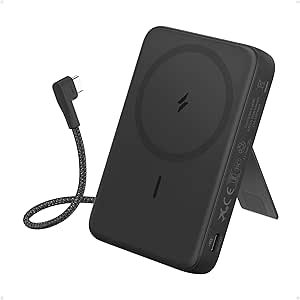
What to Know Before Buying a Compact 10,000mAh Fast-Charging Power Bank
The INIU Power Bank stands out in the crowded portable charger market by claiming the title of 'smallest 10,000mAh 22.5W fast charging' model, a combination that appeals to buyers who prioritize portability without sacrificing capacity. As you shop, focus on real-world size, charging speed compatibility, and safety features that matter for daily carry.
Key Considerations Before Buying
- Check the actual dimensions and weight: INIU markets this as the smallest 10,000mAh power bank, but 'smallest' claims vary; compare listed measurements against your pocket or bag space. A compact size often means trade-offs in port count or cable stowage.
- Verify fast-charging compatibility: 22.5W output supports protocols like USB Power Delivery (PD) and Quick Charge, but performance depends on your phone's supported standard. Ensure your device can negotiate the highest wattage to avoid charging at standard 5V/2A speeds.
- Assess safety and certification: Look for features like overcharge, overcurrent, and short-circuit protection, and confirm the product meets local safety standards (e.g., CE, RoHS). For travel to Ireland and the EU, airline-friendly capacity (under 100Wh) is also relevant.
What Our Analysts Recommend
Quality power banks use high-density lithium-polymer cells and reputable charging chips from brands like Texas Instruments or Richtek, which improve efficiency and longevity. Build quality matters too: a sturdy casing and reinforced USB ports reduce wear from daily plugging. Also check the included cable and warranty—INIU typically offers a 3-year warranty, a sign of confidence.
Portable Power Banks Market Context
Market Overview
The portable power bank market is saturated with options ranging from no-name budget models to premium brands like Anker and RavPower. Consumers increasingly demand fast charging, compact designs, and transparency about cell quality, as cheap units often exaggerate capacity. Regulatory scrutiny and consumer awareness are rising, especially in the EU where safety and labeling standards are enforced.
Common Issues
Common problems include inflated capacity claims (a '10,000mAh' bank may deliver far less usable energy), slow charging due to outdated ports, and short lifespan from low-quality cells. Overheating and swelling are safety concerns with uncertified products. Additionally, many power banks fail to include necessary cables or wall adapters, adding hidden costs.
Quality Indicators
Look for clear specifications: actual output wattage per port, supported fast-charging protocols, and cell type (lithium-polymer is preferable). Reviews mentioning real-world charging cycles and durability are telling. Certifications like CE, FCC, and RoHS, plus a responsive warranty, signal a reputable manufacturer.
Review Authenticity Insights
Grade B Interpretation
A Grade B authenticity rating with an estimated 15% fake review percentage means the review pool is largely genuine but not pristine—roughly one in seven reviews may be incentivized or exaggerated. The adjusted rating of 4.50/5 (down from 4.89) still indicates strong satisfaction, but the drop suggests some inflated praise. All reviews are verified purchases, which reduces (but doesn't eliminate) the risk of manipulation.
Trust Recommendation
Trust the overall sentiment but discount extreme praise; focus on reviews that describe specific use cases, charging times, and longevity. Given the high volume (24,223 reviews), patterns in critical reviews are more reliable than individual five-star ratings. Cross-reference with expert reviews or YouTube tests for unbiased performance data.
Tips for Reading Reviews
For power banks, prioritize reviews that mention battery degradation over months, actual charging speed tests, and compatibility with specific phone models. Ignore generic one-liners like 'great product' and look for details about size, weight, and port durability. Reviews with photos or measured capacity tests are especially valuable.
Expert Perspective
The INIU 10,000mAh power bank appears to be a solid choice for buyers seeking a pocketable fast-charging solution from a brand with a growing reputation. Its high adjusted rating (4.50) and verified-purchase reviews suggest reliable performance, though the 15% fake review estimate warrants some caution. The 22.5W output is competitive for its class, but real-world speed depends on your device. Overall, it balances size, capacity, and price well, but don't expect premium build quality at this price point.
Purchase Considerations
Weigh the trade-off between ultra-compact size and features like dual outputs or a digital display, which are often omitted in the smallest models. Check whether the 22.5W output is sufficient for your phone's fast-charging standard—some devices require higher wattage for full-speed charging. Also consider whether you need pass-through charging or airline compliance for travel.
Comparing Alternatives
Compare with similar 10,000mAh fast-charging power banks from Anker, RavPower, and Xiaomi, which may offer better build quality or additional ports at a slightly higher price. Reading side-by-side comparisons of actual capacity tests can reveal which model truly delivers the most usable power.