
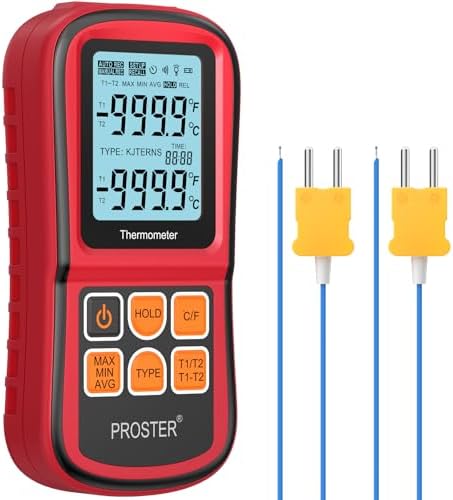
Choosing a Dual-Channel K-Type Thermocouple Meter for Professional and Hobbyist Applications
The Proster dual-channel K-type thermometer represents a specific class of temperature measurement tools designed for users who need to monitor two points simultaneously or compare temperatures. With its wide -50℃ to 1300℃ range and included probes, this device bridges professional HVAC/industrial needs and demanding hobbyist applications like pottery kilns or pool system monitoring. Buyers should understand that K-type thermocouples, while versatile, have different accuracy profiles than other sensor types.
Key Considerations Before Buying
- The dual-channel functionality is essential for differential temperature measurements, such as checking inlet/outlet temps in HVAC systems or monitoring ambient vs. surface temperatures in pottery kilns.
- The -50℃ to 1300℃ range covers extreme applications, but accuracy typically varies across this span—K-type probes are generally most accurate in the 200°C to 1250°C range.
- The included probes are likely basic wire sensors; for specialized applications (liquid immersion, high-velocity air flows), you may need to purchase additional probe types separately.
What Our Analysts Recommend
Quality indicators for this product category include clear channel differentiation on the display, robust probe connectors that resist wear, and a data hold function that actually freezes readings without delay. The LED backlight should be evenly distributed and usable in low-light workshop environments, not just dim office lighting.
Digital Thermometers Market Context
Market Overview
The market for dual-channel K-type thermometers has expanded from purely industrial users to include serious hobbyists in ceramics, home brewing, and automotive tuning. This has created a segment of 'prosumer' devices like the Proster that offer industrial ranges with simplified interfaces. Prices have dropped significantly, but this sometimes comes with compromises in probe quality or long-term calibration stability.
Common Issues
Common problems include probe connector wear leading to intermittent readings, display lag when temperatures change rapidly, and inadequate instructions for configuring the dual channels independently. Some units struggle with maintaining accuracy at the extreme ends of their stated ranges, particularly below freezing or above 1000°C.
Quality Indicators
Look for devices with clearly labeled input jacks for each channel, responsive buttons that provide tactile feedback, and probes with adequately insulated leads for high-temperature work. A good unit will specify its accuracy at different temperature ranges (e.g., ±1% + 1°C above 400°C) rather than giving a single optimistic figure.
Review Authenticity Insights
Grade B Interpretation
A Grade B authenticity rating with 11% estimated fake reviews suggests the majority of feedback is genuine, but there's a noticeable layer of potentially incentivized reviews. The adjusted rating dropping from 4.11 to 3.90 indicates these questionable reviews likely skew positive, meaning the true user experience might be slightly less enthusiastic than the overall average suggests.
Trust Recommendation
Focus on reviews that mention specific applications matching your intended use—HVAC technicians, potters, or pool maintenance professionals. Be particularly skeptical of reviews that praise generic 'build quality' without detailing actual use cases or that mention receiving the product at a discount in exchange for feedback.
Tips for Reading Reviews
Look for reviews that discuss probe replacement, calibration over time, or battery life under continuous use—these indicate long-term ownership. Reviews mentioning the dual-channel functionality in practice (e.g., 'I use channel A for ambient and channel B for surface temperature') typically reflect genuine usage patterns.
Expert Perspective
The Proster thermometer occupies a practical middle ground in the dual-channel market, offering industrial temperature ranges at a consumer-friendly price point. The 3.90 adjusted rating suggests it performs adequately for most applications but may have consistency issues—common in this price segment. The inclusion of two basic probes makes it immediately usable, though serious users will likely invest in specialized probes for their specific applications. The LED backlight and data hold functions address real workshop needs, not just marketing checkboxes.
Purchase Considerations
Consider whether you truly need the full -50℃ to 1300℃ range or if a narrower, potentially more accurate range would suffice. The dual channels are valuable if you regularly compare temperatures or need backup measurement capability. Weigh the cost of additional probes against buying a more expensive kit that includes specialized sensors from the start.
Comparing Alternatives
Shoppers should compare probe compatibility, warranty terms, and available accessories with similar units from Uni-T, Fluke, or Testo in the same price bracket.


