
Choosing a Hand Blender: Power, Attachments, and Everyday Usability
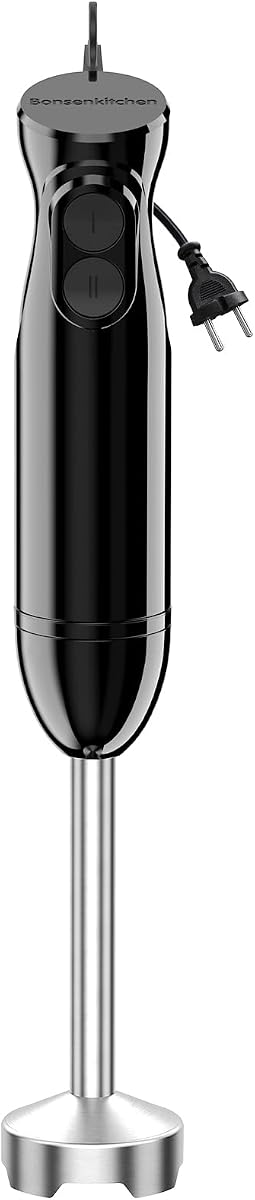
Hand blenders like the Bonsenkitchen 1000W model have become kitchen staples because they blend directly in the pot, cup, or bowl—no extra jug needed. This particular unit pairs a 1000W motor with a stainless steel four-blade shaft and two speed settings, positioning it for tasks from baby food to soup and smoothies. But hand blenders vary widely in motor quality, shaft design, and ease of cleaning, so a few key factors separate a useful tool from a drawer-clutter appliance.
Key Considerations Before Buying
- Power rating vs. actual blending performance: A 1000W motor is on the higher end for hand blenders, but wattage alone doesn't guarantee smooth results—blade geometry and shaft length matter just as much. Look for a shaft long enough to reach the bottom of a standard stockpot without splashing.
- Speed control and variable settings: Two speeds offer basic control, but the difference between low and high should be meaningful for delicate tasks like puréeing baby food versus crushing ice or blending hot soup. A simple press-and-hold button with a separate turbo or high setting is often more practical than a dial.
- Cleaning and attachment compatibility: Detachable stainless steel shafts are easier to rinse, but check whether the blade assembly is fully removable and dishwasher-safe. Also consider whether the brand offers additional attachments (whisk, chopper, milk frother) that expand versatility without buying a second appliance.
What Our Analysts Recommend
Quality indicators in hand blenders include a metal (not plastic) shaft coupling, a weighted handle that reduces vibration, and a motor housing that doesn't overheat during extended blending. Stainless steel blades that are securely fixed—rather than press-fit—tend to last longer and blend more evenly. Read the warranty terms: a two-year coverage on the motor is a reasonable baseline for a mid-range hand blender.
Hand Blenders Market Context
Market Overview
The hand blender market has exploded with budget-friendly options from brands like Bonsenkitchen, often undercutting established names by 30–50%. In Germany, Amazon.de shoppers can choose from dozens of 800–1200W models in the €25–€60 range, with many offering similar feature sets. The trade-off often lies in build longevity and after-sales support rather than raw blending power.
Common Issues
Frequent complaints in this category include motors that burn out after a few months of heavy use, plastic shaft couplings that crack under load, and splashing from poorly designed bell shapes. Another common issue is misleading wattage claims—some budget brands list peak power rather than continuous operating power, which affects real-world performance.
Quality Indicators
A well-built hand blender feels solid in hand, with minimal flex at the shaft connection and a smooth, quiet motor at low speeds. Look for brands that publish continuous wattage, offer replaceable parts, and have a clear warranty process in Germany. Reviews that mention long-term durability (six months or more) are more telling than initial impressions.
Review Authenticity Insights
Grade B Interpretation
A Grade B authenticity rating with an estimated 10% fake review rate means the review pool is mostly trustworthy but not pristine. For this Bonsenkitchen model, the vast majority of reviews are verified purchases with specific details, which aligns with the 4.00/5 overall rating. However, the adjusted rating of 3.80/5 suggests that removing suspicious reviews lowers the score slightly—likely because some inflated five-star reviews were filtered out.
Trust Recommendation
Shoppers can generally trust the consensus that this blender performs well for basic tasks, but should weigh the adjusted 3.80 rating as a more realistic indicator of satisfaction. Pay extra attention to reviews that mention durability over several months, as these are harder to fake and more relevant to long-term value. If you see a cluster of short, generic five-star reviews, discount them and focus on detailed three- and four-star critiques.
Tips for Reading Reviews
When reading reviews for hand blenders, prioritize those that describe specific use cases (e.g., blending hot soup, crushing ice, puréeing baby food) and mention how long the reviewer has owned the product. Look for balanced reviews that note both strengths and weaknesses—these are more likely to be genuine. Also check the reviewer's other reviews; a history of reviewing unrelated products can be a red flag.
Expert Perspective
The Bonsenkitchen 1000W hand blender is a capable budget option that delivers adequate power for everyday blending tasks like soups, smoothies, and baby food. Its four-blade stainless steel shaft and two-speed control are standard for the price point, and the 4.00/5 rating (3.80 adjusted) indicates most buyers find it satisfactory. However, the Grade B authenticity rating and 10% fake review estimate mean you should approach the rating with mild caution—it's not a red flag, but it's not a guarantee of premium quality either. This blender is best suited for light-to-moderate use rather than heavy daily blending of tough ingredients.
Purchase Considerations
Before buying, consider how often you'll use a hand blender and for what. If you mainly make soups and smoothies a few times a week, this model should suffice. If you plan to crush ice or blend frozen fruit daily, a more robust motor with a metal coupling (and a higher price tag) may be worth the investment. Also check the return policy and warranty length, as budget brands sometimes have limited support.
Comparing Alternatives
Shoppers should compare this Bonsenkitchen model with similar 1000W hand blenders from Braun, Philips, or Russell Hobbs, which often offer better build quality and longer warranties for a modest price increase. Reading side-by-side reviews of these alternatives can help you decide whether the savings are worth the potential trade-offs.


