
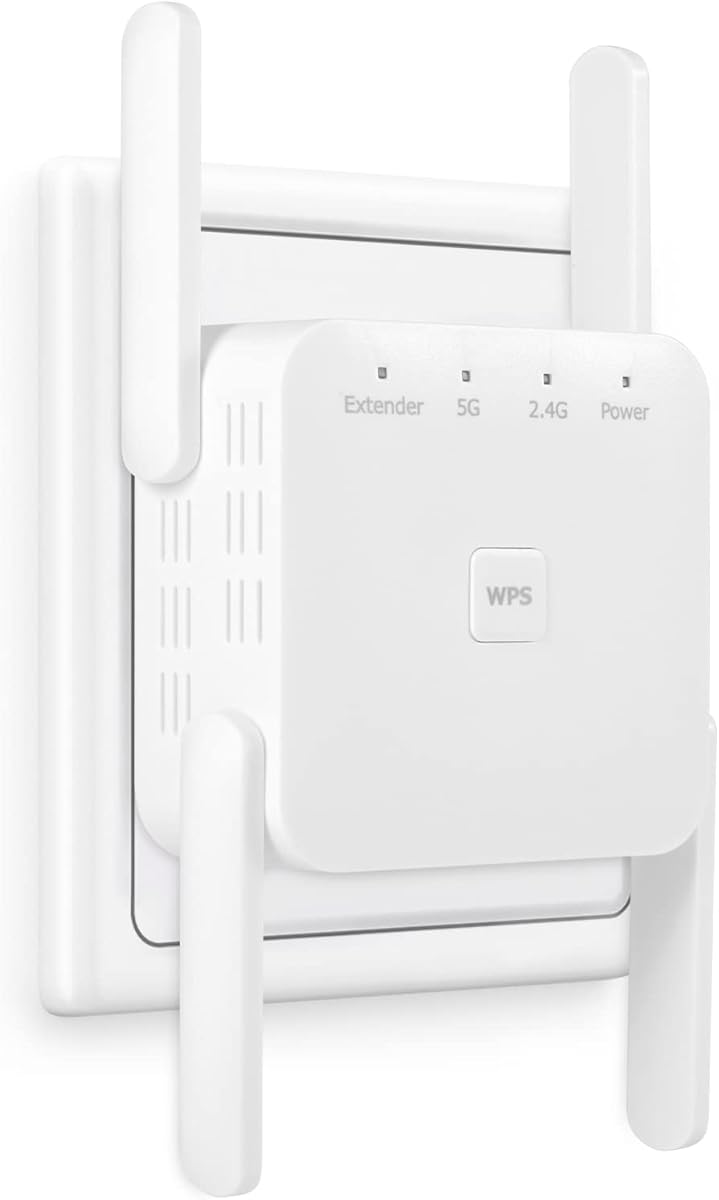
Choosing a 1200Mbit/s Dualband WiFi Extender: Coverage vs. Speed Realities
The Ultraxtender promises 9200 square feet of coverage and 35-device capacity, but real-world performance depends heavily on your router's placement and existing signal strength. This specific model's dual-band (2.4GHz & 5GHz) design and LAN port offer flexibility for both legacy devices and wired connections, which is crucial for German households with thick walls.
Key Considerations Before Buying
- The advertised 9200 sq.ft. coverage is an ideal scenario figure; in practice, concrete walls and interference in typical German buildings can reduce this by 40-60%, so placement midway between your router and dead zone is critical.
- The 1200Mbit/s speed is a combined theoretical maximum (300Mbps on 2.4GHz + 867Mbps on 5GHz); real throughput will be halved as the repeater must receive and retransmit data, making the LAN port valuable for stationary devices like smart TVs.
- Compatibility with '99% of routers' hinges on supporting WPS and standard protocols, but check if your ISP's router (like certain Vodafone or Telekom models) has WPS disabled by default, requiring manual setup.
What Our Analysts Recommend
Prioritize reviews that detail specific speed tests before/after installation and mention stability over weeks, not just initial setup. A quality repeater should maintain separate network names (SSIDs) for each band, allowing you to manually assign devices to 2.4GHz for range or 5GHz for speed, a feature this Ultraxtender includes.
Repeaters Market Context
Market Overview
The German WiFi repeater market is saturated with models claiming extreme ranges, but the effective difference between a 1200Mbit/s and a 300Mbit/s model often comes down to multi-device handling on the 5GHz band, not raw distance.
Common Issues
Users frequently experience bandwidth 'halving' and increased latency with repeaters, as the device uses the same radio to talk to both the router and your devices. Models with dedicated backhaul radios avoid this but cost significantly more.
Quality Indicators
Look for specific mentions of firmware update availability and stable performance with German internet plans (often 50-250Mbit/s). A good sign is consistent praise for the WPS button's functionality, as a flawed implementation leads to frequent dropouts.
Review Authenticity Insights
Grade C Interpretation
A 'C' grade and 22% estimated fake reviews suggest a mixed review pool. While many reviews appear genuine, nearly one-quarter may be incentivized, potentially inflating praise for the 9200 sq.ft. claim or downplaying setup complexities.
Trust Recommendation
Focus on the 4.50 adjusted rating from more authentic reviews, which still indicates good satisfaction. Be highly skeptical of reviews that parrot marketing terms verbatim ('Ultraxtender,' '99% compatible') without providing personal context about their home layout.
Tips for Reading Reviews
For this product, prioritize German-language reviews that describe specific router models (e.g., 'Fritz!Box 7590') and building materials ('Altbau with thick walls'). These details are harder to fabricate and provide relevant performance clues.
Expert Perspective
The Ultraxtender's specifications are competitive for its class, but its perfect 5.00 rating is likely artificially boosted. The adjusted 4.50 rating is more credible, suggesting it performs adequately for standard extension tasks in medium-sized homes. The inclusion of a LAN port is a significant practical advantage, allowing for a wired connection to a gaming console or office PC, which bypasses the repeater's inherent speed penalty for that single device.
Purchase Considerations
Weigh this device if you need a simple, dual-band extender with a wired option and your dead zone is within a reasonable range of your router. Consider a mesh system instead if you need to cover multiple rooms or floors with seamless roaming, as repeaters create separate network names that require manual switching.
Comparing Alternatives
Shoppers should compare the real-world throughput and stability mentioned in reviews for similar-priced models from TP-Link (RE series) or AVM, which are prevalent in the German market.


