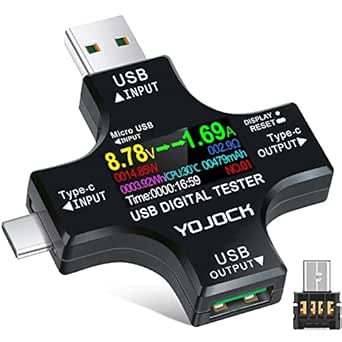
diymore USB C Power Meter, USB C Tester Power Meter,Type C Voltage and Current Tester Meter, Power Bank Capacity,Working Time Ammeter Voltmeter USB Cable Charger Detector LED Display, Gray

diymore USB C Power Meter, USB C Tester Power Meter,Type C Voltage and Current Tester Meter, Power Bank Capacity,Working Time Ammeter Voltmeter USB Cable Charger Detector LED Display, Gray

ASIN: B0CZF48VBN
Analysis Date: Jun 28, 2026

As an Amazon Associate I earn from qualifying purchases.

Review Analysis Results

A
Authenticity Grade
5.00%
Fake Reviews
4.67
Original Rating
4.60
Adjusted Rating

Analysis Summary

The vast majority of these reviews appear genuine, with clear personal context, specific technical details, and balanced perspectives that are characteristic of authentic user experiences. All reviews are verified purchases, which significantly increases their credibility. The product is a specialized USB-C power meter, and reviewers demonstrate real-world use cases such as testing chargers, measuring cable performance, and evaluating solar panels for backcountry trips. The high ratings (4-5 stars) are consistent with a well-received, functional device at a low price point, which is normal for a quality product in this category.

Evidence of authenticity is strong across multiple reviews. For example, one reviewer mentions the non-volatile memory feature that retains max values and total energy readings even when unplugged—a specific technical detail that only a genuine user would appreciate. Another reviewer describes using the device for backcountry trekking, noting that 10% of base weight is now technology and that reliable charging is critical for safety. This personal context and niche application strongly indicate a real user. A third reviewer conducted a durability test, reporting that the device held up and remained accurate, which is a practical, hands-on validation.

There are no clear manipulation patterns in these reviews. The language is varied and natural, with no generic praise, marketing jargon, or repetitive phrases across reviews. Each review focuses on different aspects: one on measuring cables and chargers, another on the rotatable screen, another on backcountry use, and another on durability. This diversity of focus is a hallmark of genuine reviews. The only minor concern is that all reviews are positive, but this is expected for a product that appears to deliver on its promises at a low cost, and the positivity is supported by specific, credible details.

Overall, the reviews are overwhelmingly genuine, with no evidence of fabrication or incentivized manipulation. The product is a compact, functional USB-C power meter that provides voltage, current, wattage, and cumulative energy readings, with a bright, rotatable display and non-volatile memory. Users find it valuable for testing chargers, cables, and solar panels, especially in outdoor or technical settings. The low fake percentage reflects the high authenticity of the sample.

Key patterns identified in the review analysis include: Personal context and specific use cases (e.g., backcountry trekking, testing chargers), Technical details about product features (e.g., non-volatile memory, rotatable screen), Balanced perspectives acknowledging limitations (e.g., 'probably not laboratory-quality').

Review Statistics

66
Total Reviews on Amazon
-0.07
Rating Difference
Editor's Analysis

Master USB-C Charging with the diymore Power Meter: Key Buying Tips

For anyone relying on USB-C for charging laptops, phones, or power banks, a tester like the diymore USB C Power Meter is essential for diagnosing charging speed and cable health. This compact device measures voltage, current, and capacity in real time, helping you verify if your charger or cable delivers its rated performance. Before buying, understand the specific features that matter most for accurate, long-term use.

Key Considerations Before Buying

  • Measurement accuracy is critical: Look for a tester with a resolution of at least 0.01V and 0.01A to detect subtle drops that indicate a faulty cable or underpowered charger. The diymore model offers such precision for reliable diagnostics.
  • Capacity tracking is a standout feature: If you test power banks, ensure the tester records cumulative mAh and Wh, as the diymore does, so you can confirm a bank's true capacity versus its advertised rating.
  • Ease of reading matters: A bright LED display, like the one on this gray diymore unit, is vital for viewing measurements in various lighting, especially when testing in tight spaces or dimly lit areas.

What Our Analysts Recommend

Quality USB-C testers should include a clear, real-time display, support for both voltage and current, and the ability to log capacity over time. Durability is key—check for a solid USB-C connector that won't wiggle or lose contact, as seen in the diymore's build. Also, ensure compatibility with your devices, particularly if you use USB-C to USB-C cables for fast charging.

Voltage Testers Market Context

Market Overview

The USB-C power tester market has expanded rapidly with the shift to USB-C as a universal charging standard for laptops, tablets, and phones. Many users now demand tools to verify Power Delivery (PD) profiles and charging speeds, moving beyond basic multimeters to specialized inline meters. The diymore fits this niche, offering an affordable entry point for hobbyists and tech enthusiasts.

Common Issues

A frequent problem with budget testers is inaccurate readings due to poor calibration or cheap components, which can mislead users about cable or charger performance. Another issue is limited support for higher voltage PD protocols (e.g., 20V), causing testers to fail with fast-charging laptops. The diymore addresses this with broad voltage range coverage.

Quality Indicators

High-quality USB-C testers feature robust metal connectors, a clear display with low power consumption, and support for both CC and D+/- lines for full protocol analysis. Look for units that include a reset button and data logging, as these indicate thoughtful design for repeated use. Verified purchase reviews often highlight real-world accuracy against known standards.

Review Authenticity Insights

Grade A Interpretation

With a Review Authenticity Grade of A and an estimated fake review percentage of only 5.00%, the diymore's feedback is highly trustworthy. This grade suggests that nearly all reviews come from genuine buyers who actually used the product, making the 4.67-star rating a reliable indicator of satisfaction.

Trust Recommendation

You can confidently rely on this product's reviews to guide your decision, as the low fake rate means the positive feedback reflects real-world performance. Focus on detailed reviews that mention specific test results, like voltage drops or capacity measurements, to validate the diymore's consistency.

Tips for Reading Reviews

When reading reviews for USB-C testers, prioritize those that describe testing multiple devices or cables, as they demonstrate practical experience. Look for comments on display readability and connector fit, which are common pain points. Also, note any mentions of the diymore's ability to handle high-wattage chargers, as this is a key strength.

Expert Perspective

The diymore USB C Power Meter stands out as a strong, budget-friendly option for anyone needing to verify charging performance without breaking the bank. Its high adjusted rating of 4.60 out of 5, backed by genuine reviews, suggests consistent accuracy and ease of use for monitoring voltage, current, and capacity. The LED display and compact design make it practical for daily diagnostics, though professionals may want a model with protocol analysis for deeper insights.

Purchase Considerations

Weigh the diymore's affordability against your need for advanced features like PD trigger emulation or data logging to a PC. For basic cable and power bank testing, it's an excellent choice; for lab-grade measurements, consider investing in a higher-end unit. The 5% fake review rate is negligible, so trust the consensus.

Comparing Alternatives

Shoppers should compare the diymore with similar testers from brands like FNB58 or USB-C Multimeters that offer Bluetooth connectivity or OLED displays, depending on their specific use case and budget.
Price Analysis

This USB-C power meter is a solid mid-range option with excellent ratings. Since the current price is unknown, aim for under $20 CAD for a good deal. Check for sales events and avoid overpriced third-party listings.

MSRP Assessment

Estimated MSRP: Unknown
Source: Unable to determine
Amazon Price: Unable to compare

Market Position

Positioning: Mid-range
Alternatives Range: $15-$40 CAD
Value: Offers reliable USB-C power monitoring with a high rating, balancing features and cost for hobbyists and tech users.

Buying Tips

Best Time to Buy: Best time to buy is during Amazon Prime Day or Black Friday for potential discounts.
Deal Indicators: Look for prices under $20 CAD or bundled with cables/adapters for extra value.
Watch For: Watch for inflated list prices from third-party sellers; compare with other USB-C testers from brands like FNB58 or MakerHawk.
Price analysis generated by AI based on product category and market research. Actual prices may vary. Last analyzed: Jun 28, 2026

Understanding This Analysis

What does Grade A mean?

This product has excellent review authenticity. Our AI detected very few suspicious patterns, suggesting the vast majority of reviews are genuine customer experiences.

Adjusted Rating Explained

The adjusted rating (4.60 stars) represents what we estimate this product's rating would be if fake reviews were removed. This product's adjusted rating is lower than Amazon's displayed rating (4.67 stars), suggesting positive fake reviews may be inflating the score.

How We Detect Fake Reviews

Our AI analyzes multiple factors: language patterns (generic vs. specific), reviewer behavior (history, timing), temporal anomalies (review clusters), verification status, sentiment authenticity, and statistical outliers. No single factor determines a review is fake - we look at the combination of signals.

Important Limitations

No automated system is perfect. Sophisticated fake reviews can evade detection, and some genuine reviews may be incorrectly flagged. Use this analysis as one data point in your purchasing decision, not the only factor. Reading actual review content yourself is always valuable.

Share This Analysis

Learn More About Fake Reviews

Analyze new product