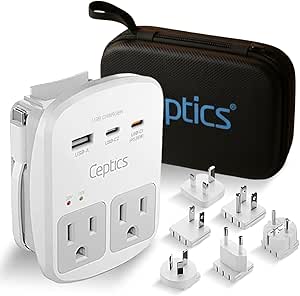
Choose the Right Universal Travel Adapter for Your Global Trips
When shopping for a universal travel adapter like the VINTAR with 3 USB-C and 2 USB-A ports, it's crucial to understand that this device is a plug adapter, not a voltage converter. This means it allows your devices to fit into foreign outlets but does not convert electrical output—so it's safe for dual-voltage gadgets like phones and laptops, but not for high-power appliances like hair dryers.
Key Considerations Before Buying
- Check your devices' voltage ratings: Most modern electronics (phone chargers, laptops) are dual-voltage (100-240V), making a simple adapter sufficient. For single-voltage devices (typically 110V in North America), you'll need a separate converter to avoid damage.
- Assess your charging needs: With 3 USB-C and 2 USB-A ports, the VINTAR can charge multiple devices simultaneously. However, its total output is limited to 6A (shared across ports), so charging speed may drop when all ports are in use—ideal for overnight or low-power devices.
- Verify compatibility with your destinations: This adapter covers Type C (Europe), G (UK), A (USA/Canada), and I (Australia/China) outlets. Ensure it includes the specific plug types for your travel itinerary, as some countries (e.g., Brazil, South Africa) use different configurations.
What Our Analysts Recommend
Quality indicators include robust pin construction (metal rather than flimsy plastic), a secure locking mechanism to prevent accidental disconnection, and safety certifications like CE, FCC, or RoHS. The VINTAR's all-in-one design should slide smoothly and lock firmly in place without wobbling.
International Power Adapters Market Context
Market Overview
The universal travel adapter market has expanded rapidly with the rise of global travel and multi-device users. Brands like VINTAR compete on port count, compactness, and compatibility, but many budget options lack safety features or fail under heavy use. The 10% estimated fake review rate for this product is relatively low, indicating a generally authentic market segment.
Common Issues
Users often report adapters that overheat when charging high-power devices, loose connections that cause intermittent charging, or plugs that don't fit snugly into outlets. Another frequent complaint is the lack of surge protection—important for expensive electronics in regions with unstable power grids.
Quality Indicators
Look for adapters with built-in safety shutters, fire-resistant materials (e.g., polycarbonate), and clear labeling of output specs. Verified purchaser reviews that mention long-term durability or specific travel scenarios (e.g., 'used in 10 countries without issue') are strong signals of quality.
Review Authenticity Insights
Grade B Interpretation
With a Review Authenticity Grade of B and only 10% estimated fake reviews, the VINTAR's review pool is largely trustworthy. This means the 960 reviews likely reflect genuine user experiences—both positive and negative—providing a reliable basis for your decision.
Trust Recommendation
Focus on reviews that detail real-world usage, such as specific countries visited or types of devices charged. Since the fake rate is low, you can trust the overall rating trends, but still watch for overly generic praise or repeated phrases that might indicate incentivized reviews.
Tips for Reading Reviews
Sort reviews by 'Most Recent' to see current quality control, and look for those that mention the adapter's performance with multiple devices or in specific outlet types. Also, check for any recurring complaints about overheating or loose pins, as these are common issues in this category.
Expert Perspective
The VINTAR Universal Travel Adapter offers a solid balance of port variety and compatibility for most travelers, especially those carrying multiple USB-C devices. Its 3 USB-C ports are a standout feature in a market still dominated by USB-A, though the shared 6A output means it's best for low-power charging. The Grade B review authenticity adds confidence, but the absence of voltage conversion limits its use for high-wattage appliances.
Purchase Considerations
Weigh the number of USB-C ports against your device needs—if you primarily use older USB-A cables, this adapter may have more USB-C than necessary. Also, consider your travel frequency: for occasional trips, this is a cost-effective choice; for frequent globetrotters, a model with surge protection or higher amperage might be worth the investment.
Comparing Alternatives
Shoppers should compare the VINTAR with adapters offering higher total output (e.g., 8A or 10A) or additional safety certifications, especially if charging multiple tablets or laptops simultaneously.