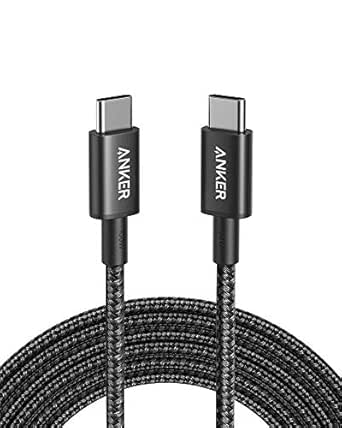
What to Know Before Buying a 10FT USB-C Cable 2-Pack
This 2-pack of 10-foot USB-A to USB-C cables is aimed at people who need extra reach for charging and syncing—whether from a wall adapter to a couch or a car charger to a back seat. The braided jacket and 2-pack format are the headline features, but the cable's real-world performance depends on a few details that aren't always obvious from the listing.
Key Considerations Before Buying
- Length affects charging speed: a 10-foot passive USB-A to USB-C cable has higher resistance than a 3-foot cable, so expect slower charging than a short cable, especially with high-wattage fast-charge adapters. If you need maximum speed, use the shortest cable that reaches.
- USB-A to USB-C is not the same as USB-C to USB-C: this cable works with USB-A ports (older chargers, car ports, power banks), but it won't deliver USB Power Delivery fast charging the way a C-to-C cable paired with a PD charger can. Check your charger's port type before buying.
- Device compatibility is broad but not universal: the listing cites iPhone 16/15 Pro Max and Galaxy S23/S22/S21/S20/S10/Note 20, which covers most modern phones. However, some devices (e.g., certain laptops or tablets) require a C-to-C cable or higher wattage, so confirm your device's charging spec.
What Our Analysts Recommend
Look for a cable with a reinforced strain relief at both connectors and a braided jacket that feels tightly woven—these are the first points of failure in long cables. Also check the connector housing for a snug fit; loose USB-C plugs cause intermittent charging. Finally, verify the cable is rated for the wattage your charger delivers (e.g., 3A for 15W–18W, 5A for higher).
USB Cables Market Context
Market Overview
The USB-C cable market is flooded with low-cost options, and 'fast charge' claims are often vague—many cables support only standard 2.4A charging, not USB Power Delivery. Long cables (10ft+) are a niche within this market, and quality varies widely because added length increases signal loss and voltage drop.
Common Issues
Common complaints in this category include cables that stop charging after a few months due to frayed connectors, slow charging despite 'fast charge' labeling, and data transfer speeds that are far below USB 2.0 expectations. With 10-foot cables, users also report voltage drop that triggers 'slow charging' warnings on some phones.
Quality Indicators
A quality USB-C cable will list explicit electrical ratings (e.g., 3A, 5A, 480Mbps) and use 22–28 AWG wire for power and data. Braided nylon jackets and aluminum connector shells are good signs, but the internal wire gauge matters more for performance. Certifications like USB-IF are rare at this price point, so look for specific, verifiable specs rather than marketing terms.
Review Authenticity Insights
Grade B Interpretation
A Grade B authenticity score with an estimated 10% fake review rate means the review set is mostly genuine but not pristine—about 1 in 10 reviews may be incentivized or manipulated. The adjusted rating of 4.60/5 (down from 4.89/5) suggests that after filtering suspicious reviews, the product still rates well, but the drop indicates some inflated praise.
Trust Recommendation
Trust the adjusted 4.60 rating more than the headline 4.89, and treat the 2,817 reviews as a large but slightly noisy sample. Given that all reviews are marked verified, the risk of outright fakes is lower, but still read the middle-tier (3-star) reviews for balanced feedback on durability and charging speed.
Tips for Reading Reviews
For USB cables, prioritize reviews that mention longevity (e.g., 'still working after 6 months') and specific charging behavior (e.g., 'charges my S23 at 15W'). Ignore reviews that only praise the length or price without performance details—those are less informative and more likely to be generic.
Expert Perspective
This 2-pack of 10-foot braided USB-A to USB-C cables is a practical buy for households that need long reach at a low cost per cable, and the 4.60 adjusted rating suggests it performs reasonably well for most buyers. However, the USB-A interface limits fast-charging potential compared to C-to-C cables, and the 10-foot length may underdeliver on speed with high-wattage chargers. The braided build is a plus for durability, but long-term strain relief remains the key unknown. At this price, it's a reasonable value if your expectations are aligned with USB-A charging speeds.
Purchase Considerations
Weigh your charger type first: if you have a USB-C PD charger, this cable won't unlock its full speed—you'd need a C-to-C cable. If you mostly charge from USB-A ports (car, older wall adapters, power banks), this cable is a good fit. Also consider whether you need data transfer; this cable is likely USB 2.0 (480Mbps), which is fine for charging but slow for file transfers.
Comparing Alternatives
Shoppers should compare this with C-to-C cables if they own USB-C PD chargers, and with shorter 6-foot cables if charging speed is the priority. Also check for explicit wattage ratings (e.g., 60W, 100W) if you plan to use it with laptops or tablets.